

Financial markets are influenced by a wide range of factors that extend beyond individual companies and stock prices. Economic growth, interest rates, global events, commodity prices, currency movements, and investor sentiment all play a role in shaping market trends.
Understanding these broader forces helps investors see the bigger picture behind market movements and make more informed decisions. While individual stocks may attract the most attention, they often move in response to developments happening across the economy and financial system.
In this section, we will explore the key elements that drive markets, including global market trends, benchmark indices, volatility, currencies, commodities, sector dynamics, institutional activity, IPOs, and corporate actions. Together, these concepts provide a foundation for understanding how markets function and how different factors influence investment opportunities.
Lesson 1: Global Markets & Their Impact on India
The Indian stock market may appear to be driven primarily by domestic factors such as economic growth, corporate earnings, government policies, and investor sentiment. However, modern financial markets are deeply interconnected, and events occurring in one part of the world can quickly influence markets across the globe.
Today, businesses operate internationally, supply chains span multiple countries, and investors move capital across borders in search of opportunities. As a result, developments in major economies such as the United States, China, Japan, and Europe often affect not only their domestic markets but also emerging markets like India.
For investors, understanding global markets is important because market movements are rarely driven by a single factor. A rise in crude oil prices, changes in global interest rates, geopolitical conflicts, or shifts in investor sentiment can impact stock prices, sectors, currencies, and economic growth. Many market movements that seem unexpected at first glance become easier to understand when viewed through a global lens.
While company-specific analysis remains important, investors who understand the broader global environment often have a clearer perspective on the opportunities and risks affecting their investments.

Why Global Markets Matter
India is one of the world’s fastest-growing major economies, but it is also closely integrated with the global financial system. The country imports energy, exports goods and services, receives foreign investment, participates in global trade, and competes for international capital.
Because of these connections, developments outside India can have a meaningful impact on domestic markets.
Global markets influence India through several channels:
- Foreign investment flows
- International trade
- Commodity prices
- Currency movements
- Interest rates
- Economic growth trends
- Investor sentiment
For example, when global investors become optimistic about economic growth, they often allocate more capital to emerging markets, including India. On the other hand, during periods of uncertainty, investors may reduce risk and move funds toward safer assets, affecting market liquidity and valuations.
Major Global Economies
Although every country contributes to the global economy, a few economies play a particularly important role in shaping financial markets.
United States
The United States is the largest economy in the world and home to some of the world’s most influential financial markets. Decisions made by the US Federal Reserve regarding interest rates and monetary policy are closely monitored because they affect global liquidity and capital flows.
The performance of the US economy often influences investor sentiment worldwide.
China
China is one of the world’s largest manufacturing hubs and a major consumer of commodities. Changes in Chinese economic growth can affect demand for metals, energy, industrial goods, and international trade.
As a result, developments in China often influence commodity-producing countries and related sectors globally.
Europe
Europe represents a significant share of global economic activity. Economic growth, inflation trends, and policy decisions within the region can influence international trade, business confidence, and investment flows.
Japan and Other Asian Economies
Japan remains one of the world’s largest economies and an important participant in global trade and technology. Investors also monitor other Asian economies because they often provide early indications of regional economic trends and investor sentiment.
Global Stock Market Indices
Investors often use stock market indices to assess the health of major economies and gauge market sentiment.
Some of the most widely followed global indices include:
- S&P 500 (United States)
- Nasdaq Composite (United States)
- Dow Jones Industrial Average (United States)
- FTSE 100 (United Kingdom)
- DAX (Germany)
- Nikkei 225 (Japan)
- Hang Seng Index (Hong Kong)
These indices are closely watched because they reflect the performance of major companies and provide insights into investor expectations regarding economic growth and corporate earnings.
A strong rally or sharp decline in these markets can influence sentiment across global financial markets, including India.
Global Capital Flows
One of the most important links between global and Indian markets is the movement of capital.
Large institutional investors continuously evaluate opportunities across countries and asset classes. Money may flow into equities, bonds, commodities, or currencies depending on economic conditions and expected returns.
When investors are confident about growth prospects, capital often flows into emerging markets. During periods of uncertainty, money may move toward traditionally safer assets.
These shifts in capital can influence stock prices, currency movements, and overall market performance.
Economic & Geopolitical Events
Global markets are constantly influenced by economic and geopolitical developments.
Some of the most important factors include:
- Interest rate decisions
- Inflation trends
- Economic growth data
- Trade policies
- Elections
- Wars and geopolitical conflicts
- Sanctions and trade restrictions
- Supply chain disruptions
Such events can affect investor confidence, business activity, commodity prices, and financial markets worldwide.
How Global Events Affect Indian Markets
Global developments often influence India through multiple channels at the same time.
For example:
- Rising crude oil prices can increase costs for businesses and affect inflation.
- Changes in US interest rates can influence foreign investment flows.
- A slowdown in global growth can affect exports and corporate earnings.
- Currency fluctuations can impact importers, exporters, and multinational companies.
- Geopolitical tensions can increase market volatility and uncertainty.
Understanding these relationships helps investors connect market movements to broader economic developments rather than viewing them as isolated events.
Key Takeaways
- Financial markets around the world are interconnected.
- Major economies such as the United States, China, Europe, and Japan significantly influence global markets.
- Global indices provide insights into investor sentiment and economic expectations.
- Capital flows, commodity prices, currencies, and interest rates act as important transmission channels.
- Economic and geopolitical developments can affect Indian markets even when there is little domestic news.
- Understanding global markets helps investors develop a broader perspective and make more informed investment decisions.
Lesson 2: Commodities & Their Market Impact
Introduction
Most investors focus on stocks and pay little attention to commodities. However, commodities play a critical role in the global economy and often have a significant impact on businesses, sectors, inflation, and stock market performance.
Crude oil powers transportation and industry, metals are used in manufacturing and infrastructure, and precious metals often influence investor sentiment during periods of uncertainty. Changes in commodity prices can affect production costs, profit margins, consumer spending, and economic growth.
For this reason, understanding commodities is important even for investors who never trade them directly.
What Are Commodities?
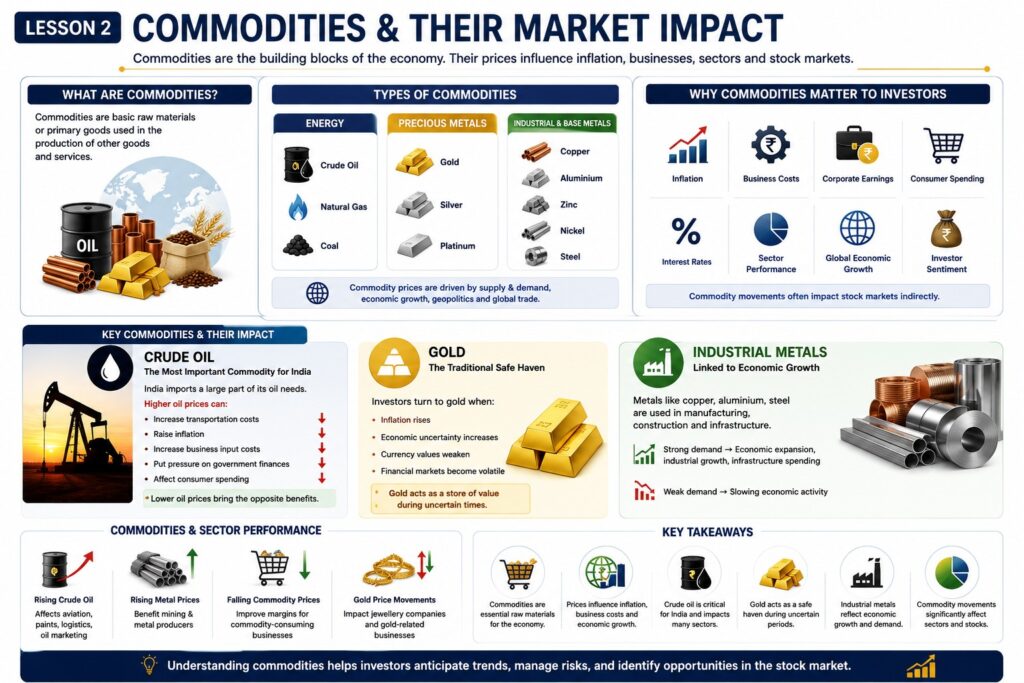
Commodities are basic raw materials or primary goods that are used in the production of other goods and services.
They are generally classified into three broad categories:
Energy Commodities
- Crude Oil
- Natural Gas
- Coal
Precious Metals
- Gold
- Silver
- Platinum
Industrial & Base Metals
- Copper
- Aluminium
- Zinc
- Nickel
- Steel
Commodity prices are largely driven by supply and demand dynamics, economic growth, geopolitical events, and global trade activity.
Why Commodities Matter to Investors
Commodity prices influence:
- Inflation
- Business costs
- Corporate earnings
- Consumer spending
- Interest rates
- Sector performance
As a result, commodity movements often affect stock markets indirectly.
Crude Oil: The Most Important Commodity for India
Among all commodities, crude oil deserves special attention because India imports a significant portion of its energy requirements.
Higher crude oil prices can:
- Increase transportation costs
- Raise inflation
- Increase input costs for businesses
- Put pressure on government finances
- Affect consumer spending
Lower crude oil prices often provide the opposite benefits.
Because of its widespread impact, crude oil is closely monitored by investors, policymakers, and businesses.
Gold: The Traditional Safe Haven
Gold has historically been viewed as a store of value during periods of uncertainty.
Investors often turn to gold when:
- Inflation rises
- Economic uncertainty increases
- Currency values weaken
- Financial markets become volatile
While gold does not generate earnings like a business, it remains an important asset in global financial markets.
Industrial Metals & Economic Growth
Industrial metals such as copper, aluminium, steel, and zinc are closely linked to manufacturing, construction, and infrastructure activity.
Strong demand for these metals often indicates:
- Economic expansion
- Industrial growth
- Infrastructure spending
Weak demand may signal slowing economic activity.
For this reason, investors often use industrial metals as indicators of broader economic trends.
Commodities and Sector Performance
Commodity prices can have a direct impact on various sectors.
Examples include:
- Rising crude oil prices can affect aviation, paints, logistics, and oil marketing companies.
- Rising metal prices can benefit mining and metal producers.
- Falling commodity prices can improve margins for commodity-consuming businesses.
- Gold price movements can influence jewellery companies and gold-related businesses.
Understanding these relationships helps investors identify both opportunities and risks.
Key Takeaways
- Commodities are essential raw materials used throughout the economy.
- Commodity prices influence inflation, business costs, and economic growth.
- Crude oil is one of the most important commodities for India.
- Gold often acts as a safe-haven asset during uncertain periods.
- Industrial metals provide insights into economic activity and demand.
- Commodity movements can significantly affect sector and stock performance.
The hidden truth is:
Commodity prices often affect company profits before management does anything.
Example 1: Crude Oil & Aviation Companies
Imagine:
Crude Oil = $60/barrel
An airline’s fuel cost is manageable.
Now crude rises:
$60 → $90 → $110
What happens?
- Aviation fuel becomes expensive
- Operating costs rise
- Profit margins shrink
- Earnings fall
Result:
Airline stocks may fall even if passenger traffic remains strong.
Real-World Logic
Higher crude oil
↓
Higher fuel cost
↓
Lower profit
↓
Stock under pressure
Example 2: Crude Oil & Paint Companies
Most people don’t realize paint companies use petroleum-based inputs.
Suppose crude rises sharply.
Raw material costs increase.
If the company cannot immediately raise paint prices:
- Margins decline
- Earnings suffer
This is why paint stocks often react to crude prices.
Example 3: Gold & Jewellery Companies
Suppose:
Gold = ₹60,000 per 10 grams
Then gold rises:
₹60,000 → ₹80,000
Consumers may postpone purchases.
Jewellery demand may slow.
However, companies holding gold inventory may see inventory value rise.
This creates both opportunities and challenges.
Example 4: Copper & Infrastructure Growth
Copper is used in:
- Electrical wiring
- Power infrastructure
- Construction
- Electric vehicles
When copper demand rises globally:
Investors often assume:
- Manufacturing is improving
- Infrastructure spending is increasing
- Economic activity is strengthening
That’s why copper is sometimes called:
“Dr. Copper”
because it often reflects economic health.
Example 5: Steel Prices & Construction
Suppose steel prices rise sharply.
Who benefits?
- Steel manufacturers
Who suffers?
- Construction companies
- Infrastructure projects
- Real estate developers
Why?
Because input costs increase.
The same commodity creates winners and losers.
Example 6: Weak Rupee + Crude Oil = Double Impact
Suppose:
Crude = $80
USD/INR = 80
Oil Cost = ₹6,400
Now:
Crude remains $80
But USD/INR rises to 90
Oil Cost becomes:
₹7,200
Oil price didn’t change.
Currency changed.
This is why commodity investors also watch currencies.
Example 7: Metal Companies During a Commodity Cycle
Suppose global demand increases.
Prices rise:
- Copper
- Aluminium
- Zinc
- Steel
Mining companies suddenly earn much higher profits.
Their stock prices often rise before earnings reports because markets anticipate higher profits.
This is called a:
Commodity Upcycle
Example 8: Commodity Downcycle
Now imagine:
China slows down.
Global demand weakens.
Metal prices fall.
Result:
- Revenue falls
- Margins shrink
- Mining profits decline
Even well-managed companies may struggle because the commodity cycle has turned against them.
The Most Important Commodity for India
If you only track one commodity, track:
Crude Oil
Because it affects:
- Inflation
- Government finances
- Transportation
- Aviation
- Logistics
- Chemicals
- Paints
- Consumer spending
- Interest rates
Few commodities have such a widespread impact on the Indian economy.
How Professional Investors Use Commodities
Retail investors often ask:
“Which stock is moving?”
Professional investors ask:
“Why is the stock moving?”
Many times the answer is:
- Crude oil
- Copper
- Steel
- Gold
- Natural gas
Because commodity prices directly influence company earnings.
Simple Framework
Whenever a commodity price changes, ask:
Who Produces It?
(Usually benefits when prices rise)
Examples:
- Oil producers
- Metal miners
- Steel manufacturers
Who Consumes It?
(Usually suffers when prices rise)
Examples:
- Airlines
- Paint companies
- Construction companies
- Manufacturers
This one framework alone will help investors understand a large percentage of commodity-related stock movements.
Lesson 3: VIX, Currency & Interest Rates
Stock prices are influenced by more than just company earnings and economic growth. Investor sentiment, currency movements, and interest rates can have a significant impact on market behavior, often affecting entire sectors and asset classes at the same time.
Understanding these factors helps investors interpret market volatility, anticipate risks, and gain a better understanding of the forces driving financial markets.
In this lesson, we will explore three important concepts: volatility, currency markets, and interest rates.
Understanding Volatility
Volatility refers to the rate at which prices move up or down over a period of time. Markets with large and frequent price swings are considered highly volatile, while markets with smaller and more stable movements are considered less volatile.
Volatility itself is neither good nor bad. It simply reflects the level of uncertainty and investor expectations in the market.
Periods of high volatility are often associated with:
- Economic uncertainty
- Geopolitical events
- Financial crises
- Major policy announcements
- Unexpected market developments
What Is India VIX?
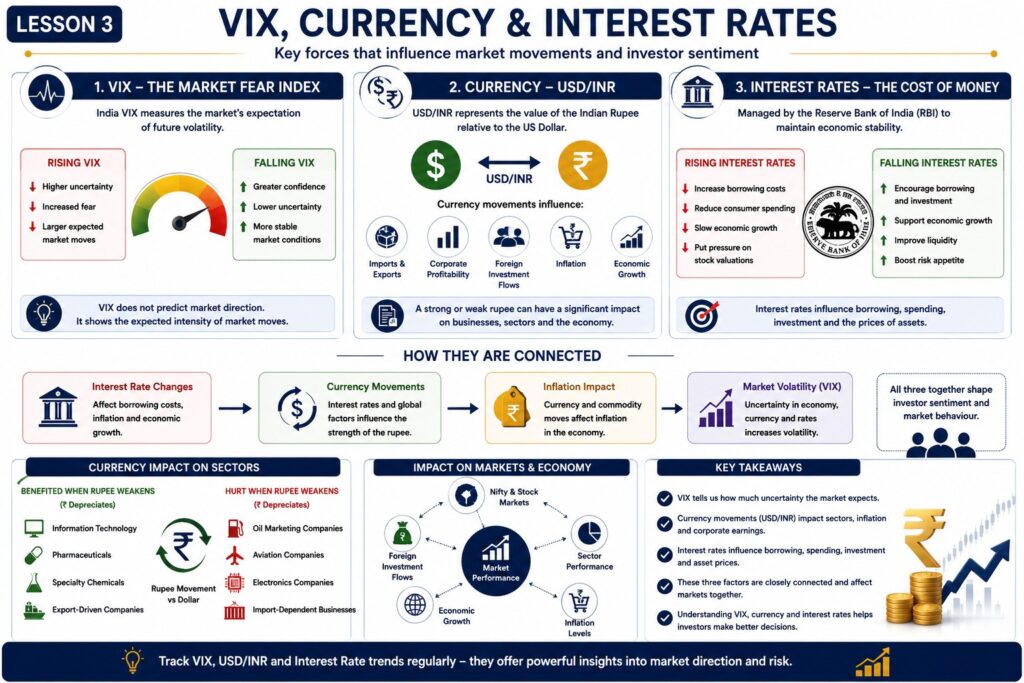
India VIX, often referred to as the “Fear Index,” measures the market’s expectation of future volatility.
A rising VIX generally indicates:
- Higher uncertainty
- Increased fear among investors
- Larger expected market movements
A falling VIX generally indicates:
- Greater confidence
- Lower uncertainty
- More stable market conditions
It is important to remember that VIX does not predict market direction. Instead, it reflects the expected intensity of future market movements.
Example 1: Calm Market
Imagine Nifty is at 25,000.
There is:
- No major election
- No war
- No RBI announcement
- No global crisis
Investors are comfortable and expect normal market movements.
Result:
- India VIX = 11 or 12
This suggests the market expects relatively small daily fluctuations.
Example 2: Election Uncertainty
Suppose a major election result is due next week.
Nobody knows:
- Who will win
- What policies will change
- How markets will react
Investors start buying options to protect themselves.
Option prices rise.
Result:
- India VIX jumps from 12 to 22
This does not mean the market will definitely fall.
It means traders expect large movements in either direction.
Example 3: COVID Crash (Fear)
During early 2020:
- Businesses shut down
- Global economies stopped
- Nobody knew the impact
Investors rushed for protection.
Option premiums exploded.
India VIX rose above 80.
That was extreme fear.
Markets were expecting massive volatility.
Understanding VIX Levels
| India VIX | Meaning |
|---|---|
| Below 12 | Very calm market |
| 12-15 | Normal conditions |
| 15-20 | Increased uncertainty |
| 20-30 | High volatility |
| Above 30 | Fear and panic |
| Above 50 | Extreme uncertainty |
These are not fixed rules but useful guidelines.
Important Point
Low VIX ≠ Market Will Rise
Example:
- Nifty = 25,000
- VIX = 11
Market can still fall.
It simply means investors don’t expect a large move.
High VIX ≠ Market Will Fall
Example:
- Election result day
- VIX = 25
Market might:
- Rise 5%
- Fall 5%
VIX is saying:
“A big move is coming, but I don’t know which direction.”
Why Investors Should Watch VIX
VIX helps investors understand:
- Market sentiment
- Fear levels
- Risk appetite
- Expected volatility
Think of it like a weather forecast.
- Nifty = Today’s weather
- India VIX = Tomorrow’s storm warning
The weather may be sunny today, but if the storm warning suddenly increases, investors should be prepared for larger market swings.
Real-Life Analogy
Imagine you’re driving.
- The speedometer tells you how fast you’re currently going.
- The weather forecast tells you how rough the road ahead might be.
Nifty is the speedometer.
India VIX is the weather forecast.
That’s why professional traders and institutions watch VIX every day—it tells them how nervous or confident the market is becoming, even before large price movements occur.
Understanding Currency Markets
Currencies are traded in the foreign exchange market, commonly known as the Forex market. Exchange rates determine how much one currency is worth relative to another.
For Indian investors, the most closely watched currency pair is:
USD/INR
This represents the value of the Indian Rupee relative to the US Dollar.
Currency movements influence:
- Imports and exports
- Corporate profitability
- Foreign investment flows
- Inflation
- Economic growth
Because India participates extensively in global trade, exchange rate movements can have a meaningful impact on businesses and markets.
How Currency Movements Affect Different Sectors
The impact of currency fluctuations varies across industries.
Export-Oriented Sectors
A weaker rupee may benefit:
- Information Technology
- Pharmaceuticals
- Specialty Chemicals
- Export-focused manufacturers
Because revenue earned in foreign currencies becomes more valuable when converted back into rupees.
Import-Dependent Sectors
A weaker rupee may negatively affect:
- Oil marketing companies
- Aviation companies
- Electronics manufacturers
- Businesses dependent on imported raw materials
Because input costs increase when imports become more expensive.
Understanding Currency Beyond USD/INR
Most people think currency is only relevant for forex traders.
In reality, currency movements affect:
- Inflation
- Interest rates
- Foreign investments
- Corporate earnings
- Commodity prices
- Government finances
- Consumer spending
- Stock market valuations
Even if you never trade currencies, they affect almost every investment you make.
What Does USD/INR Actually Mean?
Suppose:
1 USD = ₹80
This means:
One US Dollar can buy ₹80.
If USD/INR rises to ₹85:
The Dollar has strengthened.
The Rupee has weakened.
If USD/INR falls to ₹75:
The Rupee has strengthened.
The Dollar has weakened.
Hidden Impact #1: Foreign Investors Care About Currency
Imagine a US fund invests:
$1 million in India
At:
USD/INR = 80
Investment Value = ₹8 crore
Suppose stock prices don’t move at all.
But USD/INR moves from:
80 → 88
Now when the investor converts money back:
₹8 crore ÷ 88
= only $909,000
Even though stocks didn’t fall, the investor lost money due to currency.
This is why FIIs constantly watch currencies.
Many investors focus only on stock returns.
Institutions focus on:
Stock Return + Currency Return
Hidden Impact #2: Currency Can Override Earnings Growth
Suppose:
An IT company grows profit by 15%.
Sounds great.
But if the Rupee strengthens significantly:
Foreign revenue converts into fewer rupees.
Actual earnings growth may become:
15% → 8%
This is why export companies often discuss currency impacts during earnings calls.
Hidden Impact #3: Currency and Inflation
India imports:
- Crude Oil
- Natural Gas
- Electronics
- Machinery
- Chemicals
Suppose:
Crude Oil = $80
USD/INR = 80
Cost = ₹6,400
Now Rupee weakens:
USD/INR = 90
Same oil price.
New cost = ₹7,200
Oil didn’t become expensive.
The currency did.
This imported inflation eventually affects:
- Petrol
- Diesel
- Transportation
- Food
- Manufacturing
Hidden Impact #4: Currency Influences RBI Decisions
Weak currency often creates inflation pressure.
Higher inflation may force RBI to:
- Increase interest rates
- Tighten liquidity
Which can affect:
- Banking
- Real Estate
- Auto
- Capital Goods
A simple currency move can eventually impact the entire stock market.
Hidden Impact #5: Currency Impacts Commodity Prices
Most commodities are priced in US Dollars.
Examples:
- Crude Oil
- Gold
- Silver
- Copper
- Aluminium
Suppose:
Gold Price = $2,000
If Dollar strengthens and Rupee weakens:
Gold can become expensive in India even if global gold prices remain unchanged.
This is why gold prices in India don’t always move exactly like global gold prices.
Hidden Impact #6: Currency Signals Economic Strength
Strong currencies often indicate:
- Stable economy
- Strong capital inflows
- Investor confidence
Weak currencies may indicate:
- Capital outflows
- Inflation concerns
- Economic uncertainty
Currency markets often react faster than stock markets.
Many institutions watch currencies as an early warning signal.
Hidden Impact #7: Currency Creates Sector Winners & Losers
Beneficiaries of Weak Rupee
- IT
- Pharma
- Specialty Chemicals
- Textile Exporters
- Auto Ancillaries Exporters
Reason:
Foreign revenue converts into more rupees.
Sectors Hurt by Weak Rupee
- Aviation
- Oil Marketing
- Electronics
- Paints
- Import-heavy Manufacturers
Reason:
Import costs increase.
Hidden Impact #8: Currency Affects Market Sentiment
When investors see:
- Rupee falling rapidly
- Dollar strengthening sharply
They often assume:
- FII selling may increase
- Inflation may rise
- RBI may intervene
This can influence market sentiment even before earnings are affected.
The Professional Investor View
Retail Investors often ask:
“Which stock should I buy?”
Professional Investors ask:
“What is happening to interest rates, inflation, commodities, and currencies?”
Because these macro forces eventually affect:
- Sectors
- Earnings
- Valuations
- Market direction
That’s why currency is not a forex topic.
It’s a market topic, because it silently influences almost every part of the financial system.
Understanding Interest Rates
Interest rates represent the cost of borrowing money and are among the most influential factors in financial markets.
In India, the Reserve Bank of India (RBI) plays a key role in managing interest rates and maintaining economic stability.
Interest rates affect:
- Consumer spending
- Business investment
- Loan growth
- Inflation
- Asset prices
Changes in interest rates can influence the valuation of stocks, bonds, real estate, and other assets.
Why Interest Rates Matter to Investors
Rising Interest Rates
Higher interest rates may:
- Increase borrowing costs
- Reduce consumer spending
- Slow economic growth
- Put pressure on stock valuations
Falling Interest Rates
Lower interest rates may:
- Encourage borrowing and investment
- Support economic growth
- Improve liquidity
- Boost risk appetite
As a result, investors closely monitor interest rate decisions and central bank policy statements.
Interest rates are one of those topics that beginners underestimate, but institutions obsess over.
A stock can have great earnings, a strong business, and excellent management, but if interest rates move sharply, its valuation can still change significantly.
For Samnidhi, I’d teach interest rates from a market perspective, not a banking textbook perspective.
Understanding Interest Rates
Interest rates represent the cost of borrowing money and the reward for lending it.
When you take a home loan, personal loan, or business loan, you pay interest. When you keep money in a bank deposit, you earn interest.
At the economy level, interest rates influence:
- Consumer spending
- Business investment
- Economic growth
- Inflation
- Asset prices
- Stock market valuations
This is why interest rates are among the most powerful forces in financial markets.
Why Do Interest Rates Exist?
Imagine nobody charged interest.
People would borrow unlimited amounts of money.
Banks would have little incentive to lend.
The economy would become unstable.
Interest rates help balance:
- Borrowers
- Lenders
- Economic growth
- Inflation
Think of interest rates as the price of money.
Just as higher prices reduce demand for a product, higher interest rates reduce demand for borrowing.
Who Controls Interest Rates in India?
The primary institution responsible is the Reserve Bank of India (RBI).
The RBI uses monetary policy to:
- Control inflation
- Support economic growth
- Maintain financial stability
- Manage liquidity
The most important rate investors track is the:
Repo Rate
The repo rate is the rate at which commercial banks borrow money from the RBI.
When the RBI changes the repo rate, it influences borrowing costs across the economy.
Why Does RBI Increase Interest Rates?
Usually because inflation is becoming a problem.
Example:
Suppose inflation rises to 8%.
People are spending aggressively.
Businesses are raising prices.
The RBI may increase rates to slow demand.
Higher rates mean:
- Costlier loans
- Lower spending
- Slower borrowing
- Reduced inflation pressure
Why Does RBI Reduce Interest Rates?
Usually when economic growth slows.
Example:
Businesses stop investing.
Consumers reduce spending.
Loan demand falls.
The RBI may cut rates to stimulate activity.
Lower rates mean:
- Cheaper loans
- More spending
- More investment
- Faster economic growth
Hidden Impact #1: Interest Rates Affect Every Loan
When rates rise:
- Home loans become expensive
- Car loans become expensive
- Business loans become expensive
This reduces demand across the economy.
When rates fall:
- Borrowing becomes easier
- Consumption increases
- Investment increases
Hidden Impact #2: Interest Rates Influence Stock Valuations
Most investors focus on earnings.
Institutions focus on:
Earnings + Discount Rate
Future profits become less valuable when interest rates rise.
That’s why growth stocks often struggle during rising-rate environments.
Even if earnings remain strong.
Hidden Impact #3: Interest Rates Affect FII Flows
Imagine:
India Government Bond = 7%
US Treasury Bond = 3%
India looks attractive.
Now suppose:
US Treasury rises to 5.5%
Suddenly global investors may shift money back to the US.
This can affect:
- FII flows
- Rupee
- Stock markets
Many Indian investors watch Nifty.
Global funds often watch bond yields first.
Hidden Impact #4: Interest Rates Affect Currency
Higher interest rates often attract foreign capital.
Foreign investors may buy:
- Government bonds
- Corporate debt
- Financial assets
This can strengthen the currency.
Lower rates may have the opposite effect.
This is why currency and interest rates are closely connected.
Hidden Impact #5: Interest Rates Affect Real Estate
Real estate is one of the most rate-sensitive sectors.
Example:
Home Loan = ₹50 lakh
At 8% interest:
EMI = manageable
At 10% interest:
EMI rises significantly
Even small rate increases can affect housing demand.
That’s why real estate companies closely monitor RBI policy.
Hidden Impact #6: Interest Rates Affect Banks
Many beginners think:
Higher rates = bad for banks
Reality is more nuanced.
Banks earn through:
- Lending rates
- Deposit rates
- Net Interest Margin (NIM)
Sometimes rising rates help banks.
Sometimes falling rates help.
What matters is how quickly loan and deposit rates adjust.
Sector-Wise Impact
Usually Beneficiaries of Lower Rates
- Real Estate
- Auto
- Capital Goods
- Infrastructure
- Consumer Durables
Reason:
Borrowing becomes cheaper.
Usually Hurt by Higher Rates
- Highly leveraged companies
- Debt-heavy businesses
- Rate-sensitive sectors
Reason:
Interest costs rise.
Interest Rates and Market Cycles
A common pattern is:
Slow Economy
↓
RBI Cuts Rates
↓
Borrowing Increases
↓
Growth Improves
↓
Inflation Rises
↓
RBI Raises Rates
↓
Growth Slows
↓
Cycle Repeats
This cycle has been repeated across economies for decades.
What Professional Investors Watch
Most retail investors track:
- Stock prices
- News
- Earnings
Professional investors track:
- Inflation
- Interest rates
- Bond yields
- Currency
- Liquidity
Because these factors often influence market direction before earnings change.
Key Takeaway
Interest rates are not just a banking concept.
They influence:
- Stock markets
- Real estate
- Bonds
- Currency
- Inflation
- Consumer spending
- Corporate profitability
- Economic growth
In many cases, a change in interest rates can have a bigger impact on markets than a company’s quarterly earnings report. That’s why every major investor, institution, and central bank watches interest rates closely.
The Relationship Between VIX, Currency & Interest Rates
Although these factors are often discussed separately, they are closely connected.
For example:
- Rising interest rates can influence currency values.
- Currency fluctuations can affect inflation.
- Inflation can influence interest rate decisions.
- Economic uncertainty can increase market volatility and VIX.
Together, these factors help shape investor sentiment and market behavior.
Key Takeaways
- Volatility measures the degree of market price fluctuations.
- India VIX reflects expected future market volatility.
- Currency movements affect trade, inflation, and corporate earnings.
- USD/INR is one of the most important currency pairs for Indian investors.
- Interest rates influence borrowing, spending, investment, and asset prices.
- Understanding the relationship between volatility, currencies, and interest rates helps investors better interpret market conditions.