
Stock Market Basics Every Beginner Should Understand
If you are new to investing or have always found the stock market confusing, this section will help you understand how the stock market actually works — step by step, in simple language.
This section focuses on clarity, structure, and real understanding, not tips, hype, or shortcuts.
This section is ideal if you:
- Want to understand the stock market from scratch
- Feel confused by terms like shares, IPOs, and exchanges
- Want to avoid costly beginner mistakes
What You’ll Learn Here
By the end of this section, you will understand:
- What the stock market is and why it exists
- What shares represent and how ownership works
- What IPOs are and why companies go public
- How buying and selling of shares actually happens
- Who participates in the stock market
- The difference between long-term investing and short-term trading
How This Section Is Structured
This section is divided into clear, beginner-friendly lessons, designed to build understanding step by step.
Lesson 1 Introduction to the Stock Market
Before buying a stock, it’s important to understand what the stock market actually is.
The stock market is not a casino.
It is a place where business ownership is bought and sold.
This lesson focuses on clarity, not shortcuts.
Who This Lesson Is For
- Absolute beginners to the stock market
- Investors who feel confused by market terms
- Long-term investors (not traders)
- Anyone who wants to invest with understanding
What You’ll Learn in This Lesson
By the end of this lesson, you will understand:
- What the stock market really represents
- What shares and ownership mean
- Why companies come to the stock market
- How investors participate
- Common myths beginners believe
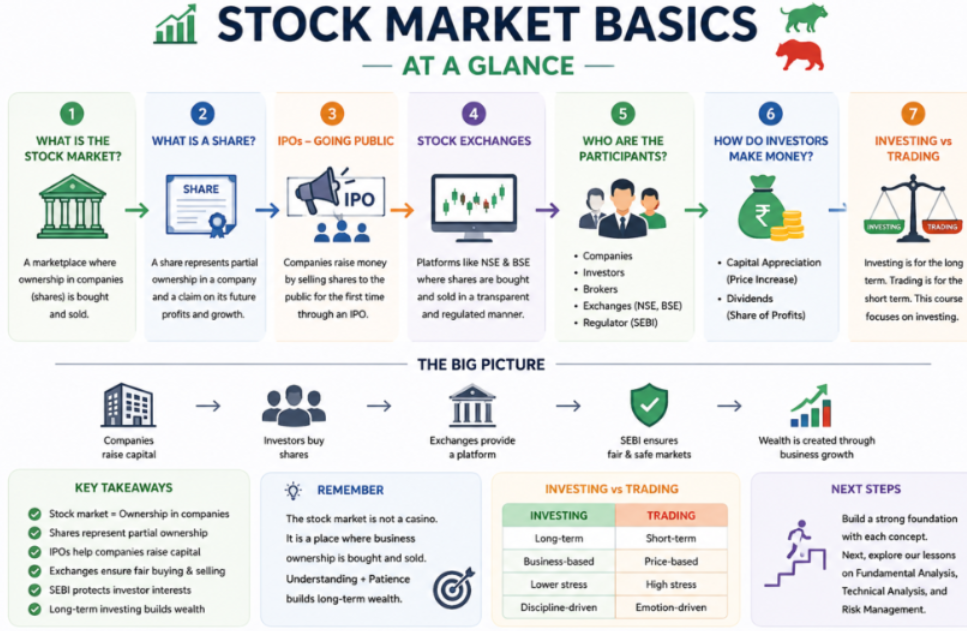
What Is the Stock Market?
The stock market is a marketplace where:
- Companies raise money
- Investors buy ownership (shares)
- Ownership is traded between investors
What Is a Share?
A share represents:
- Partial ownership in a company
- A claim on future profits
- Participation in business growth
Example:
If a company has 1,00,000 shares and you own 100 shares, you own 0.1% of that company.
Why Do Companies List in the Stock Market?
Companies enter the stock market to:
- Raise capital for growth
- Expand operations
- Reduce debt
- Improve visibility and credibility
This process is called an IPO (Initial Public Offering).
Who Are the Participants?
Main participants include:
- Companies – seeking capital
- Investors – individuals & institutions
- Stock exchanges – NSE, BSE
- Regulators – SEBI (in India)
- Brokers – facilitate transactions
The system works under rules, not chaos.
How Do Investors Make Money?
Investors earn through:
Capital appreciation
When share price rises over time
Dividends
Share of company profits paid to shareholders
Long-term wealth comes from business growth, not daily price movement.
Common Beginner Myths
Stock market is gambling
Only experts can invest
High returns are quick and easy
Timing the market is necessary
Truth:
Understanding + patience beats prediction.
Stock Market vs Trading
| Investing | Trading |
|---|---|
| Long-term ownership | Short-term price focus |
| Business-based | Price-based |
| Lower stress | High stress |
| Discipline-driven | Emotion-driven |
This course focuses on investing, not speculation.
Takeaways
- Stock market represents business ownership
- Shares are ownership units
- Companies list to raise capital
- Investors earn via growth and dividends
- Long-term mindset matters most
Lesson 2 – Shares, IPOs, Stock Exchanges & SEBI
In Lesson 1, you learned that the stock market is about ownership in companies.
In this lesson, we will break that ownership into clear building blocks and answer questions like:
- What exactly is a share?
- How do companies first sell shares to the public?
- Where does buying and selling actually happen?
- Who makes sure the system is fair and safe?
This lesson removes confusion and builds structural clarity.
What You’ll Learn in This Lesson
By the end of this lesson, you will understand:
- What a share represents
- How IPOs work (without technical jargon)
- What stock exchanges do
- Why SEBI exists and why it matters to you
What Is a Share?
A share represents a unit of ownership in a company.
When you buy a share, you:
- Become a part-owner of the company
- Share in the company’s success and failure
- Do not receive fixed returns
Important: A share is not a loan. It is ownership.
How Shareholders Can Benefit
Shareholders may benefit in two main ways:
Price Appreciation
If the company performs well, its share price may rise.
Dividends
Some companies share a portion of their profits with shareholders. Dividends are not guaranteed and depend on company decisions.
What Is an IPO?
IPO stands for Initial Public Offering.
An IPO is the process through which a private company becomes a public company by offering its shares to the public for the first time.
In simple words: An IPO is a company saying:
“We want to raise money by sharing ownership with the public.”
Why Companies Launch IPOs
Companies may go public to:
- Raise money for expansion
- Reduce debt
- Increase visibility and credibility
- Provide exit to early investors
IPO vs Stock Market Trading (Very Important)
| IPO | Stock Market Trading |
|---|---|
| First sale of shares | Buying & selling between investors |
| Company receives money | Company does NOT receive money |
| Happens only once | Happens daily |
This distinction helps you understand where your money goes.
What Is a Stock Exchange?
A stock exchange is an organized, electronic platform where shares are bought and sold.
It ensures:
- Transparency
- Fair price discovery
- Proper record-keeping
Major Stock Exchanges in India
- NSE (National Stock Exchange)
- BSE (Bombay Stock Exchange)
You cannot trade directly on exchanges. You need a broker (covered later).
What Is SEBI and Why It Matters
SEBI stands for Securities and Exchange Board of India.
SEBI is the regulator of the Indian stock market.
Role of SEBI
SEBI:
- Protects investor interests
- Regulates brokers and companies
- Prevents fraud and manipulation
- Ensures transparency and fairness
Thanks to SEBI, the stock market is regulated, not a free-for-all.
Common Beginner Misunderstandings
Let’s clear a few myths:
IPOs guarantee profits
Shares always give dividends
Exchanges control prices
SEBI ensures no losses
Reality: Markets involve risk, but regulation ensures fairness — not profits.
How This Knowledge Helps You as a Beginner
Understanding these basics helps you:
- Know what you are buying
- Avoid blind IPO investing
- Trust the system without unrealistic expectations
- Invest with clarity, not fear
Knowledge reduces mistakes, not risk.
Key Takeaways
- A share represents ownership in a company
- IPO is how companies first offer shares to the public
- Stock exchanges provide a platform for trading
- SEBI regulates and protects the market ecosystem
- Understanding structure is essential before investing
Lesson 3 – How Buying & Selling of Shares Workfar, you’ve learned:
- What the stock market is
- What shares and IPOs mean
- Where shares are traded and who regulates the market
Now comes the most practical and fear‑removing question:
How does buying and selling of shares actually happen?
This lesson explains the process step by step, without technical overload.
What You’ll Learn in This Lesson
By the end of this lesson, you will understand:
- Why you need a broker to trade
- What happens when you place a buy or sell order
- How share prices are decided
- How shares and money move after a trade
- Why prices change every second
Why You Cannot Buy Shares Directly
You cannot walk into NSE or BSE and buy shares directly.
Stock exchanges are platforms, not shops.
To trade, you need a registered intermediary called a broker.
Examples of brokers in India:
- Zerodha
- Groww
- Upstox
- Angel One
Brokers provide you access to the stock exchange using technology.
What Is a Broker?
A broker is a SEBI‑registered intermediary who:
- Allows you to place buy and sell orders
- Connects you to the stock exchange
- Handles execution and settlement
Brokers do not decide prices or guarantee profits.
What Happens When You Buy a Share?
Let’s understand this with a simple flow.
Step 1: You Place an Order
You log in to your broker’s app and place a buy order for a share.
You specify:
- Which share you want
- How many shares
- At what price (or market price)
Step 2: Order Reaches the Stock Exchange
Your broker sends your order electronically to the stock exchange.
The exchange checks:
- Is your account valid?
- Do you have enough funds?
Step 3: Order Matching Happens
The stock exchange matches:
- Buyers willing to buy
- Sellers willing to sell
A trade happens only when a buyer and seller agree on price.
Step 4: Trade Execution
Once matched:
- The trade is executed
- Price is fixed
- Both parties are notified
Step 5: Settlement (Money & Shares Transfer)
After execution:
- Money moves from buyer to seller
- Shares move from seller to buyer
This happens electronically through your Demat account.
Settlement happens in T+1 or T+2 days (depending on rules).
What Is a Demat Account? (Basic Intro)
A Demat account holds your shares in electronic form.
Think of it as:
- A digital locker for shares
You do not receive physical share certificates anymore.
(Demat accounts are covered in detail later.)
How Are Share Prices Decided?
Share prices are decided by demand and supply.
- More buyers than sellers → Price goes up
- More sellers than buyers → Price goes down
Prices change because people’s expectations about a company change.
Why Prices Change So Frequently
Prices move due to:
- Company performance
- News and announcements
- Economic conditions
- Investor sentiment
Short‑term price movement does not always reflect business value.
Common Beginner Confusions
Broker controls prices
Stock exchange sets prices. Buying means instant ownership. Prices move only on news
Reality: Prices are the result of collective buying and selling decisions.
Why This Lesson Matters
Understanding the process:
- Removes fear of the unknown
- Prevents blind clicking on apps
- Helps you invest calmly
Clarity leads to confidence.
Key Takeaways
- You trade shares through a broker
- Orders are matched on stock exchanges
- Prices depend on demand and supply
- Settlement happens electronically
- Price movement is normal and continuous
Lesson 4 Market Participants
Who Buys and Sells in the Stock Market?
Lesson Objective
By the end of this lesson, you will understand:
- Who participates in the stock market
- Why different participants behave differently
- How their actions influence prices and volatility
Why Market Participants Matter
The stock market is not a single entity.
It is a place where millions of different participants buy and sell shares for different reasons.
Understanding who is trading helps you:
- Avoid panic during volatility
- Understand sudden price movements
- Invest with realistic expectations
Retail Investors (Individual Investors)
Who are they?
- Everyday individuals like you and me
- Trade using brokers such as Zerodha, Groww, Upstox
Characteristics:
- Smaller investment size
- Mostly long-term focused
- Influenced by news, social media, emotions
Impact on Market:
- Limited price influence individually
- Collective buying/selling can move prices
Example:
A salaried professional investing ₹10,000 every month in stocks or mutual funds.
Institutional Investors
Who are they?
- Large organizations managing big money
- Examples:
- Mutual Funds
- Insurance companies
- Pension funds
- Foreign Institutional Investors (FIIs)
Characteristics:
- Large capital
- Professional research teams
- Long-term and data-driven decisions
Impact on Market:
- Can move prices significantly
- Their entry or exit creates trends
Example:
A mutual fund buying ₹500 crore worth of shares in a company.
Foreign Institutional Investors (FIIs)
Who are they?
- Institutional investors from outside India
Why FIIs matter:
- Bring foreign capital into Indian markets
- Strong influence on market direction
Effect on Markets:
- FII buying → markets usually rise
- FII selling → markets often fall
Important:
FII activity affects market sentiment, not company fundamentals.
Traders (Short-Term Participants)
Who are they?
- Participants focused on short-term price movements
Types of Traders:
- Intraday traders
- Swing traders
- Derivatives traders
Characteristics:
- High frequency of trades
- Higher risk
- Emotion and timing sensitive
Impact on Market:
- Increase liquidity
- Increase short-term volatility
Note:
Trading is not the same as investing.
Market Makers
Who are they?
- Institutions that continuously buy and sell shares
Role:
- Provide liquidity
- Reduce large bid–ask gaps
- Enable smooth trading
Without market makers:
- You may not find buyers or sellers easily
Regulators (SEBI)
Who are they?
- Securities and Exchange Board of India
Role of SEBI:
- Protect investors
- Ensure fair and transparent markets
- Prevent fraud and manipulation
Important:
SEBI does not decide prices, but ensures fair play.
How All Participants Interact Together
| Participant | Main Goal | Market Impact |
|---|---|---|
| Retail Investors | Wealth creation | Limited individually |
| Institutions | Long-term returns | Strong influence |
| FIIs | Global allocation | High volatility impact |
| Traders | Short-term profits | Liquidity & noise |
| Market Makers | Smooth trading | Stability |
| SEBI | Regulation | Trust & safety |
Key Takeaways
Markets move because of collective actions
Big players influence trends, not daily noise
Retail investors should focus on long-term goals
Understanding participants prevents emotional decisions
Lesson 5 – Long-Term Investing vs Short-Term Trading
Learn the difference between investing and trading.
You’ll understand:
- Long-term investing and wealth building
- Short-term trading and its risks
- Which approach is more suitable for beginners Long-Term Investing vs Short-Term Trading
Not everyone who enters the stock market has the same goal.
Some people want to build wealth over years.
Others want to profit from short-term price movements.
Understanding the difference between investing and trading is critical — especially for beginners.
What Is Long-Term Investing?
Long-term investing means buying ownership in businesses with the intention of holding them for many years.
The focus is on:
- Business quality
- Growth potential
- Earnings over time
- Compounding
In investing, time does most of the work.
How Wealth Is Built Through Investing
Long-term investors benefit from:
- Business growth
- Reinvested profits
- Compounding returns
- Lower transaction costs
Example:
An investor who stays invested through ups and downs often outperforms someone who trades frequently.
Patience is a competitive advantage.
What Is Short-Term Trading?
Short-term trading focuses on price movement, not business ownership.
Traders aim to:
- Buy and sell quickly
- Capture short-term opportunities
- Profit from volatility
Trading can range from:
- Short-term positional trades
- Swing trading
- Intraday trading
Trading requires speed, discipline, and emotional control.
Risks Involved in Trading
Short-term trading involves:
- Higher emotional stress
- Frequent decision-making
- Higher transaction costs
- Greater chance of mistakes
Without experience and discipline, trading losses compound quickly.
Investing vs Trading: A Simple Comparison
| Aspect | Investing | Trading |
|---|---|---|
| Time horizon | Years | Days to weeks |
| Focus | Business fundamentals | Price movement |
| Risk level | Lower (over time) | Higher |
| Skill required | Patience & analysis | Speed & discipline |
| Suitable for beginners | Yes | No (generally) |
Which Is Better for Beginners?
For most beginners:
- Long-term investing is safer
- Learning curve is smoother
- Emotional pressure is lower
Trading should be approached only after:
- Strong market understanding
- Risk management discipline
- Emotional control
You can always move from investing to trading — not the other way around.
Key Takeaways from Lesson 5
- Investing and trading serve different goals
- Long-term investing builds wealth steadily
- Trading carries higher risk and stress
- Beginners should prioritize investing
- Time and discipline matter more than speed
Lesson 6: Risks, Reality, and Beginner Awareness
Listen to this
The stock market offers opportunities — but it also involves risk.
Understanding risk early helps you stay realistic, calm, and disciplined.
This lesson prepares you mentally before you invest real money.
Why Stock Prices Fluctuate
Stock prices change because of:
- Company performance
- Economic conditions
- Interest rates
- Global events
- Market sentiment
Price movement is normal — stability is the exception.
Risk Is a Natural Part of Markets
Risk does not mean something is wrong.
It means:
- Outcomes are uncertain
- Prices move up and down
- Losses are part of the process
Even the best investors experience losses.
Common Beginner Mistakes
Many beginners lose money due to:
- Expecting quick profits
- Following tips blindly
- Overtrading
- Panic selling during market falls
- Investing without understanding
Most losses come from behavior, not lack of intelligence.
The Illusion of Easy Money
Social media often shows:
- Profits, not losses
- Success stories, not failures
- Short-term wins, not long-term reality
The stock market is not a shortcut to wealth.
Why Patience Matters More Than Prediction
You don’t need to predict:
- Market tops
- Market bottoms
- Daily price movements
You need:
- A clear process
- Time in the market
- Emotional discipline
Staying invested matters more than perfect timing.
Awareness Before Action
Before investing, always ask:
- Do I understand what I’m buying?
- Can I tolerate short-term losses?
- Is this aligned with my long-term goals?
Awareness reduces regret.
Key Takeaways from Lesson 6
- Price fluctuations are normal
- Risk cannot be avoided, only managed
- Beginner mistakes are common — and costly
- Patience and discipline protect capital
- Learning comes before investing
Lesson 7: How the Stock Market Fits into Your Financial Journey
The stock market is not the first step in personal finance — and it is not the last.
It is one part of a larger financial journey that includes earning, saving, protecting, and growing money responsibly.
Understanding where the stock market fits helps you invest with clarity instead of pressure.
The Bigger Picture of Personal Finance
A healthy financial journey usually follows this order:
- Income Stability
- Regular income from job or business
- Basic control over expenses
- Money Basics
- Budgeting
- Emergency fund
- Basic insurance
- Stock Market Participation
- Long-term investing
- Wealth creation over time
The stock market works best after your foundation is ready, not before.
Why Beginners Feel Overwhelmed
Many beginners enter the stock market with:
- Fear of missing out
- Pressure from social media
- Stories of quick profits
This creates unrealistic expectations.
The stock market rewards prepared participants, not rushed ones.
Learning before investing reduces:
- Anxiety
- Emotional decisions
- Costly beginner mistakes
Investing Is a Journey, Not an Event
The stock market is not about:
- One perfect stock
- One perfect year
- One lucky decision
It is about:
- Consistent learning
- Long-term participation
- Compounding over time
Wealth is built slowly, silently, and steadily.
Stock Market vs Other Financial Goals
The stock market should support your life goals, not dominate them.
It works best for:
- Long-term goals (5+ years)
- Wealth creation
- Inflation-beating returns
It is not suitable for:
- Emergency funds
- Short-term expenses
- Money you cannot afford to lose
Time horizon decides suitability.
Investor Mindset vs Speculator Mindset
Speculator mindset
- Looks for fast returns
- Chases trends and tips
- Reacts emotionally
Investor mindset
- Focuses on learning
- Accepts ups and downs
- Thinks in years, not days
The stock market rewards patience more than intelligence.
How Learning Fits Before Action
Before placing your first trade or investment, you should understand:
- How markets work
- How companies make money
- How risk is managed
- Why losses are normal
That is why this learning path progresses from:
- Stock Market Basics
→ Fundamental Analysis
→ Technical Analysis
→ Risk Management
Knowledge reduces fear. Process reduces mistakes.
What Responsible Progress Looks Like
A responsible beginner:
- Starts small
- Avoids leverage
- Focuses on learning, not profits
- Tracks decisions and outcomes
An irresponsible beginner:
- Goes all-in
- Follows tips
- Trades emotionally
- Learns after losing money
The difference is not intelligence — it is preparation.
Key Takeaways from Lesson 7
- The stock market is part of a larger financial journey
- Learning comes before investing
- Long-term thinking reduces risk
- Patience and discipline matter more than speed
- Confidence comes from understanding, not action
Important Note for Beginners
The stock market is not a get-rich-quick machine.
It rewards:
- Knowledge
- Patience
- Discipline
It punishes:
- Emotional decisions
- Blind tips
- Short-term thinking without learning
Understanding how the market works is more important than making your first trade.
Key Takeaways
- The stock market allows companies to grow and investors to build wealth
- Shares represent ownership in a business
- IPOs bring companies to the public market
- Long-term investing is safer for beginners
- Knowledge matters more than tips or rumors
Continue Learning
Readers can explore the official National Stock Exchange (NSE) website to understand market structure, listed companies, indices, and trading activity.
Each topic builds upon the previous concepts and is designed to help you develop a deeper understanding of investing and financial markets.