

Risk management is the most important skill in investing and trading — yet it is the most ignored.
Risk Management helps investors protect capital, control losses, and make better long-term decisions. It is one of the most important skills for achieving sustainable investing success.You can be right about markets, companies, and trends — and still lose money if risk is not controlled.
This section explains how to protect capital first, so that returns can come later.
Who This Is For
- Beginners who want to avoid common mistakes
- Investors who want long-term survival
- Traders who want consistency
Risk management is not optional — it is foundational.
What You’ll Learn Here
By the end of this section, you will understand:
- What risk really means in markets
- Why losses are part of the game
- How much to risk on a single trade or investment
- The importance of risk–reward ratios
- Emotional discipline and common mistakes
Lesson 1 – What Is Risk in the Stock Market?
Risk is the possibility of losing money.
In markets, risk comes from:
- Price volatility
- Wrong assumptions
- Unexpected news or events
- Emotional decisions
Key truth: Risk cannot be eliminated — only managed.
Beginner Example
If you invest ₹10,000 and the value drops to ₹8,000, your risk is ₹2,000.
Managing risk means deciding this loss in advance, not discovering it later.
What Creates Risk in the Market?
Risk in the stock market comes from multiple sources:
- Price Volatility
Stock prices move up and down every day. Higher volatility means higher uncertainty and higher risk. - Wrong Assumptions
Your expectations about growth, earnings, or market direction may turn out to be incorrect. - Unexpected News or Events
Policy changes, global events, earnings surprises, or management decisions can impact prices instantly. - Emotional Decisions
Fear, greed, panic, and overconfidence often lead to poor decisions that increase risk.
A Critical Truth About Risk
Risk cannot be eliminated from the stock market.
It can only be identified, measured, and managed.
Trying to avoid all risk means avoiding the market itself. Successful investors and traders accept risk but control how much they are exposed to it.
Beginner Example
You invest ₹10,000 in a stock.
- If the price falls and your investment value becomes ₹8,000
- Your loss (risk realized) is ₹2,000
Risk management means:
- Knowing before investing how much you are willing to lose
- Not reacting emotionally after the loss occurs
Risk vs Loss (Important Difference)
- Risk is the possibility of loss
- Loss is the actual loss when things go wrong
Good risk management focuses on controlling risk before a loss happens, not fixing damage later.
Why Understanding Risk Comes First
Many beginners focus on:
- How much profit they can make
- Which stock will go up
- What others are buying
Professionals focus on:
- How much they can lose
- What happens if they are wrong
- Whether the risk is worth the reward
This mindset difference separates long-term survivors from short-term participants.
Key Takeaway from Lesson 1
- Risk exists in every market decision
- Risk is unavoidable, but manageable
- Losses are part of the process, not a failure
- Understanding risk is the first step toward consistency
Lesson 2 – Why Capital Protection Comes First
In the stock market, capital is your lifeline.
Opportunities will always exist, but once capital is damaged or lost, your ability to participate in those opportunities reduces drastically. This is why experienced investors and traders prioritize protecting money before trying to grow it.
The Core Principle of Risk Management
You cannot compound returns if you cannot survive losses.
Markets reward those who stay in the game long enough. Survival always comes before growth.
Two Types of Market Participants
Over time, market participants fall into two broad categories:
Those Who Focus on Making Money
- Chase high returns
- Take large risks
- Often ignore downside
- Short-term excitement driven
Those Who Focus on Not Losing Money
- Control position size
- Accept small losses
- Think in probabilities
- Process-driven and patient
Long-term winners belong to the second group.
Why Capital Protection Is More Important Than Profits
Consider this simple math:
- If you lose 50% of your capital, you need 100% returns just to break even
- If you lose 20%, you need 25% returns to recover
The deeper the loss, the harder the recovery.
Avoiding large losses is more powerful than chasing big gains.
Beginner Example
You start with ₹1,00,000
- Scenario A:
You lose ₹50,000 due to poor risk control
Remaining capital: ₹50,000 - Scenario B:
You lose ₹10,000 with controlled risk
Remaining capital: ₹90,000
Which scenario gives you a better chance to recover and grow?
Capital protection keeps future options open.
A Simple but Powerful Rule
Markets will give you endless opportunities.
Capital will not.
If capital is protected:
- You can learn from mistakes
- You can participate in future trends
- You can improve decision-making
If capital is lost:
- Even correct ideas become irrelevant
Investor vs Trader Perspective
- Investors protect capital through:
- Diversification
- Long-term conviction
- Fundamental reassessment
- Traders protect capital through:
- Strict stop losses
- Position sizing
- Short holding periods
Different styles, same priority: capital protection.
Key Takeaways from Lesson 2
- Capital is limited, opportunities are unlimited
- Large losses destroy compounding
- Survival matters more than returns
- Protecting capital increases long-term success probability
Lesson 3 – Position Sizing: How Much to Invest
Position sizing is one of the most important yet least discussed aspects of risk management.
Even with a great idea, poor position sizing can destroy capital.
Even with an average idea, good position sizing can protect and grow capital over time.
What Is Position Sizing?
Position sizing answers one critical question:
How much of your total capital should you allocate to a single trade or investment?
It is not about which stock to buy —
it is about how much you can afford to lose if you are wrong.
Why Position Sizing Matters More Than Accuracy
Many beginners focus on:
- Finding the “best stock”
- Predicting market direction
- Being right more often
Experienced market participants focus on:
- Limiting damage when wrong
- Staying emotionally stable
- Ensuring no single decision can ruin them
You don’t need a high win rate — you need controlled losses.
The Golden Rule for Beginners
Never risk more than 1–2% of your total capital on a single idea.
This rule applies to:
- Trades
- Short-term investments
- Even long-term positions during uncertain phases
Simple Beginner Example
- Total capital: ₹1,00,000
- Maximum risk per trade (1%): ₹1,000
This means:
- Even if the trade fails, your loss is limited to ₹1,000
- You can make multiple mistakes and still survive
Survival allows learning. Learning leads to growth.
Position Size vs Amount Invested (Important Distinction)
Many beginners confuse these two:
- Amount invested → Total money put into a stock
- Position size (risk) → Maximum loss if the idea fails
Example:
- You invest ₹20,000 in a stock
- Your stop loss limits loss to ₹1,000
Your risk is ₹1,000, not ₹20,000.
Always calculate risk first, not investment size.
What Happens Without Position Sizing?
Common beginner mistakes:
- Going all-in on one idea
- Increasing position after losses
- Treating every trade as a “sure thing”
Result:
- One bad decision causes large damage
- Emotional stress increases
- Decision quality drops
Big losses don’t come from bad ideas — they come from oversized positions.
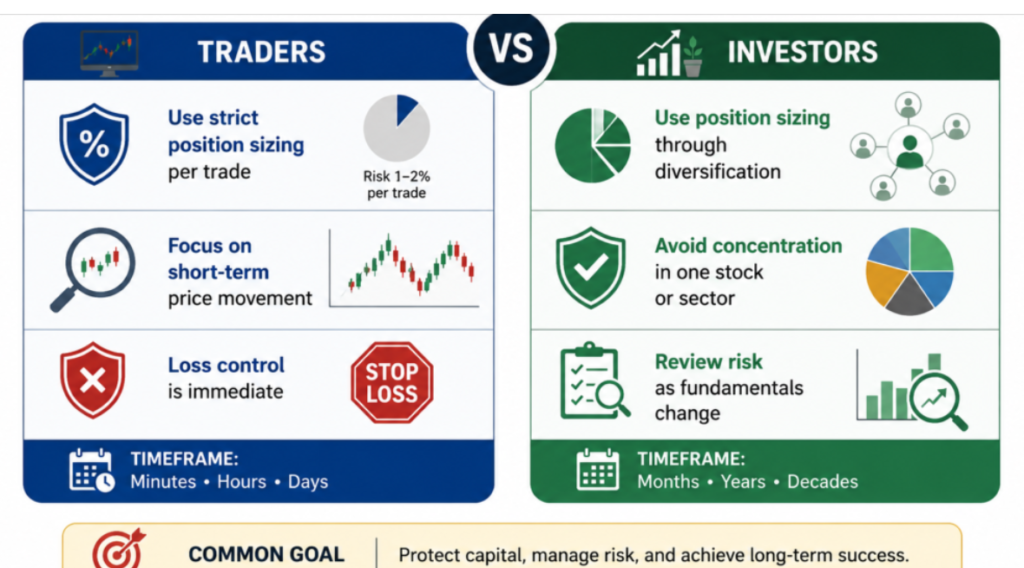
Investor vs Trader Perspective
- Traders
- Use strict position sizing per trade
- Focus on short-term price movement
- Loss control is immediate
- Investors
- Use position sizing through diversification
- Avoid concentration in one stock or sector
- Review risk as fundamentals change
Different methods, same objective: risk control.
Advanced Insight (For Intermediate & Experienced Readers)
Professional risk managers think in terms of:
- Portfolio-level risk
- Correlation between positions
- Maximum drawdown tolerance
They ask:
“What is the worst-case damage to my capital if multiple things go wrong together?”
Position sizing is portfolio protection, not just trade protection.
Key Takeaways from Lesson 3
- Position sizing defines survival
- Risk per idea should be limited
- Small losses preserve confidence
- Consistency beats aggression
- One trade should never decide your future
Lesson 4 – Stop Loss: Your Safety Net
A stop loss is one of the simplest tools in risk management — and also one of the most powerful.
It exists for one purpose only:
To protect your capital when the market proves you wrong.
Ignoring stop losses is not confidence.
It is exposure to unlimited risk.
What Is a Stop Loss?
A stop loss is a pre-defined exit point where you accept a loss and close the position.
It answers this question before you enter a trade or investment:
“If this idea fails, at what point will I exit?”
A stop loss is decided in advance — not in panic.
Why Stop Loss Matters
Without a stop loss:
- Losses can grow uncontrollably
- Emotions take over decision-making
- One bad position can damage months or years of progress
With a stop loss:
- Risk is capped
- Decisions are rule-based
- Stress reduces significantly
A stop loss turns uncertainty into a known risk.
Simple Beginner Example
- You buy a stock at ₹500
- You decide you will exit if price falls to ₹470
Your stop loss:
- ₹30 per share
- Risk is defined before entry
If the price hits ₹470:
- You exit
- Loss is controlled
- Capital is preserved for the next opportunity
The goal is not to avoid losses — it is to limit them.
Stop Loss Is Not Failure
Many beginners believe:
- “Stop loss means I was wrong”
- “Good investors don’t need stop losses”
Reality:
- Every professional accepts losses
- Discipline matters more than ego
- Small losses are part of the process
A stop loss is not admitting defeat — it is practicing discipline.
Trader vs Investor Perspective on Stop Loss
Traders
- Use price-based stop losses
- Focus on charts and technical levels
- Exit quickly when price structure breaks
Investors
- Use broader stop loss logic:
- Fundamental deterioration
- Business thesis invalidation
- Time-based exit if expectations fail
Different methods, same goal: capital protection.
Common Stop Loss Mistakes
Not using a stop loss at all
Moving stop loss lower to “avoid loss”
Setting stop loss randomly without logic
Removing stop loss once trade goes against you
Decide stop loss before entry
Accept small losses calmly
Stick to your plan
Most big losses start as small losses that were ignored.
Advanced Insight (For Intermediate & Experienced Readers)
Professionals think of stop losses as:
- Risk control tools
- Portfolio damage limiters
- Emotional stabilizers
They ask:
“Is this loss acceptable relative to my total capital?”
The market does not punish mistakes — it punishes undisciplined mistakes.
Key Takeaways from Lesson 4
- Stop loss protects capital
- Losses are planned, not accidental
- Discipline beats prediction
- Small losses enable long-term survival
- No stop loss = unlimited risk
Lesson 5 – Risk–Reward Ratio: The Mathematics of Survival
Risk–reward ratio is where discipline meets logic.
You do not need to predict markets perfectly to succeed.
You need to ensure that your potential gains are larger than your potential losses.
This lesson explains how risk–reward thinking allows even average accuracy to produce long-term success.
What Is Risk–Reward Ratio?
Risk–reward ratio compares:
How much you are willing to lose
versus
How much you aim to gain
It is expressed as:
- Risk : Reward
Example:
- Risk ₹1,000
- Potential reward ₹3,000
→ Risk–Reward = 1 : 3
This means you risk 1 unit to make 3 units.
Why Risk–Reward Is More Important Than Win Rate
Many beginners believe:
- “I need to be right most of the time”
Professionals know:
- “I need my winners to be bigger than my losers”
Example:
- Win 4 trades, lose 6 trades
- Average loss: ₹1,000
- Average gain: ₹3,000
Result:
- Total loss = ₹6,000
- Total gain = ₹12,000
- Net profit = ₹6,000
You can lose more often and still make money.
Simple Beginner Example
- Entry price: ₹200
- Stop loss: ₹190 → Risk = ₹10
- Target price: ₹230 → Reward = ₹30
Risk–Reward:
- 1 : 3
This trade can be wrong more than half the time and still remain profitable.
What Is a Good Risk–Reward Ratio?
General guidelines:
- 1 : 1 → Not attractive for beginners
- 1 : 2 → Minimum acceptable
- 1 : 3 or higher → Preferred
Higher reward justifies taking the risk.
Risk–Reward Must Be Planned Before Entry
Risk–reward is not calculated after entering a trade.
You must define:
- Entry
- Stop loss
- Target
Before placing the trade.
If risk–reward is poor, skip the trade — no matter how exciting it looks.
Common Risk–Reward Mistakes
Taking trades with small reward and large risk
Hoping price will move further without planning
Ignoring risk–reward because of “strong feeling”
Entering trades without defined exit levels
Always calculate risk–reward first
Skip trades with poor structure
Be patient for quality setups
Bad trades don’t fail — they were flawed from the start.
Investor vs Trader Perspective
Traders
- Apply risk–reward on each trade
- Use price targets and stop losses
- Focus on short-term probability
Investors
- Apply risk–reward at portfolio level
- Compare downside risk vs long-term upside
- Avoid asymmetric downside situations
Same principle, different time horizon.
Advanced Insight (For Intermediate & Experienced Readers)
Professionals evaluate:
- Expectancy = (Win rate × Average win) − (Loss rate × Average loss)
- Risk–reward directly improves expectancy
They ask:
“Does this setup have a positive mathematical edge?”
Risk–reward turns uncertainty into probability.
Key Takeaways from Lesson 5
- Risk–reward defines long-term profitability
- You don’t need high accuracy
- Bigger winners offset smaller losses
- Planning exits is mandatory
- Discipline beats prediction
Lesson 6 – Emotional Risk: The Silent Killer
Emotional risk is the most dangerous form of risk in markets — because it is invisible.
Most people do not lose money due to lack of knowledge.
They lose money because emotions interfere with decisions.
This lesson explains how emotions increase risk and how disciplined behavior protects capital.
What Is Emotional Risk?
Emotional risk occurs when decisions are driven by feelings instead of logic, planning, and rules.
Common emotions that impact market decisions:
- Fear
- Greed
- Hope
- Ego
- Regret
Emotional risk silently overrides even the best strategies.
Why Emotions Are So Powerful in Markets
Markets involve:
- Money
- Uncertainty
- Continuous feedback (profits and losses)
This combination triggers strong emotional reactions.
Example:
- A small profit creates overconfidence
- A small loss creates panic
- A missed opportunity creates frustration
Without rules, emotions take control.
Most Common Emotional Mistakes
Fear of Missing Out (FOMO)
- Entering trades late because price is already moving
- Ignoring risk just to “not miss the move”
Result: Poor entries and bad risk–reward.
Holding Losers Too Long
- Refusing to accept a loss
- Hoping price will come back
Small losses turn into large losses.
Booking Profits Too Early
- Fear of losing unrealized gains
- Exiting winners too soon
Losses remain large, gains stay small.
Revenge Trading
- Trying to recover losses quickly
- Increasing position size after a loss
One mistake becomes many.
Why Emotional Control Matters More Than Intelligence
Markets do not reward:
- Intelligence alone
- Predictions alone
- Confidence alone
Markets reward:
- Consistency
- Discipline
- Process-driven behavior
A simple strategy executed with discipline beats a complex strategy driven by emotion.
How to Reduce Emotional Risk (Practical Rules)
Predefine entry, stop loss, and target
Risk only a small percentage per trade
Accept losses as business expenses
Avoid watching prices continuously
Stick to one strategy at a time
Rules exist to protect you from yourself.
Investor vs Trader Perspective
Traders
- Face emotions daily due to frequent decisions
- Need strict execution rules
- Must detach from individual outcomes
Investors
- Face emotions during market crashes and rallies
- Must avoid panic selling and euphoric buying
- Focus on long-term thesis
Different timeframes — same emotional challenges.
Advanced Insight (For Intermediate & Experienced Readers)
Professionals:
- Judge themselves by process, not outcome
- Measure discipline, not profits
- Focus on long-term expectancy
They ask:
“Did I follow my rules — regardless of the result?”
Process consistency creates financial consistency.
Key Takeaways from Lesson 6
- Emotional risk is unavoidable but manageable
- Losses trigger stronger emotions than gains
- Discipline reduces emotional damage
- Rules protect capital and confidence
- Survival depends on behavior, not prediction
Lesson 7 – Common Risk Management Mistakes
Most market losses are not caused by bad analysis —
they are caused by repeatable mistakes in risk management.
This final lesson highlights the most common errors investors and traders make, why they are dangerous, and what disciplined participants do differently.
Why Studying Mistakes Is Critical
Markets punish:
- Overconfidence
- Carelessness
- Shortcuts
You don’t need to be perfect — you need to avoid fatal mistakes.
The Most Common Risk Management Mistakes
Going All-In on One Idea
Putting a large portion of capital into a single stock, trade, or theme.
Why it’s dangerous
- One bad outcome can cause irreversible damage
- Increases emotional pressure
- Reduces flexibility
Disciplined approach:
- Diversify ideas
- Limit risk per position
- Assume every idea can fail
Concentration without control is gambling.
No Stop Loss or Exit Plan
Entering a position without knowing:
- Where to exit if wrong
- How much loss is acceptable
Why it’s dangerous
- Losses grow silently
- Decisions become emotional
- Capital erosion accelerates
Disciplined approach:
- Define exit before entry
- Accept small losses early
Hope is not a strategy.
Increasing Position After Losses
Also known as:
- Averaging down emotionally
- “Recovering losses” mindset
Why it’s dangerous
- Risk increases as confidence decreases
- One loss turns into a portfolio-level problem
Disciplined approach:
- Reduce size after losses
- Pause and review decisions
Bigger size should come with higher clarity — not frustration.
Overtrading
Trading too frequently without clear setups or logic.
Why it’s dangerous
- Transaction costs increase
- Decision fatigue sets in
- Emotional exhaustion rises
Disciplined approach:
- Trade only high-quality setups
- Accept that “no trade” is also a decision
Activity is not productivity.
Following Tips Blindly
Entering trades based on:
- Social media tips
- WhatsApp groups
- Rumors or excitement
Why it’s dangerous
- No clarity on risk
- No exit plan
- No accountability
Disciplined approach:
- Understand the idea yourself
- Take responsibility for every decision
If you didn’t plan the risk, you can’t manage it.
Confusing Luck with Skill
A few successful trades leading to:
- Overconfidence
- Larger position sizes
- Ignoring rules
Why it’s dangerous
- Markets eventually correct behavior
- One big loss wipes out many small gains
Disciplined approach:
- Judge performance over many trades
- Stick to rules even after wins
Markets test ego before capital.
What Disciplined Market Participants Do Differently
| Mistake | Disciplined Behavior |
|---|---|
| All-in trades | Controlled position sizing |
| No stop loss | Predefined exits |
| Revenge trading | Cooling-off periods |
| Overtrading | Selective participation |
| Tip-based decisions | Process-driven decisions |
Final Reality Check
You can:
- Be right about markets
- Understand fundamentals and charts
- Predict trends correctly
And still lose money — if risk is unmanaged.
Risk management decides who survives.
Key Takeaways from Lesson 7
- Most losses come from avoidable mistakes
- Risk control matters more than ideas
- Discipline protects capital and confidence
- Survival creates opportunity
- Process beats prediction
End of Risk Management Section
You now understand:
- What risk really means
- How to size positions
- Why stop losses matter
- How emotions increase risk
- Which mistakes to avoid