

Business Analysis
Investing is not about predicting tomorrow’s stock price. It is about understanding a business, the industry it operates in, and the factors that may drive its future growth.
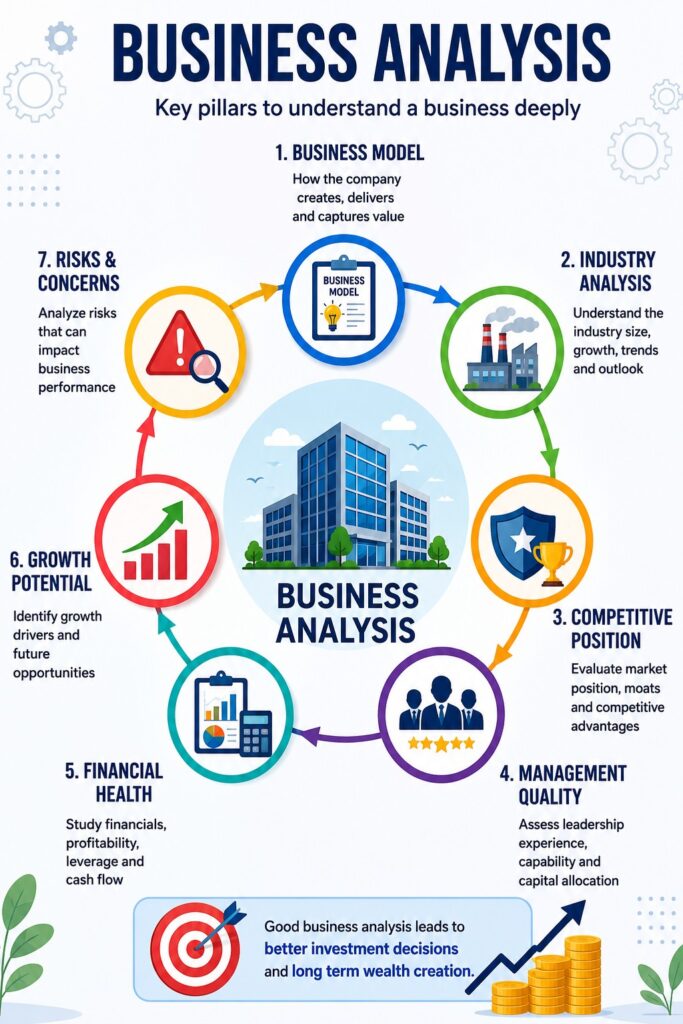
This analysis framework studies a company from the ground up. Instead of starting with financial ratios or share price movements, we begin by understanding the business itself, its industry, competitive position, growth opportunities, institutional interest, and key risks.
The objective is not to provide buy or sell recommendations, but to develop a clearer understanding of how the company creates value and the challenges it may face in the future.
By the end of this analysis, readers should have a balanced view of the business, its growth potential, and the risks that deserve careful consideration.
🔍 BUSINESS ANALYSIS FRAMEWORK
🏢 Business
↓
🏭 Industry
↓
🛡 Competition
↓
👥 Ownership
↓
📈 Growth
↓
⚠ Risks
Lesson 1: Understanding the Core Business
Why Understanding the Business Comes First
One of the most common mistakes investors make is jumping directly into financial ratios, earnings reports, and stock price charts without first understanding the business itself.
A company’s financial performance is ultimately a reflection of its business model. Revenue, profits, margins, and cash flows do not appear out of nowhere. They are the result of products being sold, services being delivered, customers making purchases, and management making strategic decisions.
Before asking whether a company is a good investment, investors should first ask a simpler question:
How does this business actually make money?
If you cannot clearly explain how a company earns revenue, who its customers are, and why those customers choose its products or services, it becomes difficult to make sense of any financial metric that follows.
Understanding the core business creates the foundation for every other part of company analysis.
What Is a Core Business?
The core business represents the primary activity through which a company generates revenue and creates value for its customers.
Every company exists to solve a problem or satisfy a need.
Banks help individuals and businesses manage money and access credit.
IT service companies help organizations manage technology and digital operations.
Paint manufacturers provide products used in construction, renovation, and decoration.
Pharmaceutical companies develop and supply medicines that address healthcare needs.
Although businesses may operate in multiple segments, there is usually one primary activity that drives the majority of revenue and profits.
Identifying this activity is the first step in understanding any company.
Questions Every Investor Should Ask
When studying a company, investors should begin by answering several basic but important questions.
What Does the Company Sell?
The first step is identifying the products or services offered by the business.
Some companies sell physical products such as automobiles, paints, steel, or consumer goods.
Others provide services such as software development, banking, insurance, consulting, or logistics.
Understanding what is being sold provides insight into the company’s market and customer base.
Who Are the Customers?
A business cannot survive without customers.
Investors should determine whether the company primarily serves:
• Individual consumers
• Businesses
• Governments
• International markets
The type of customer often influences pricing power, profitability, growth opportunities, and business risks.
A company selling essential products to millions of consumers may behave very differently from a company relying on a small number of corporate clients.
How Does the Company Earn Revenue?
Revenue can be generated in many different ways.
Some companies earn revenue through one-time product sales.
Others generate recurring income through subscriptions, maintenance contracts, service agreements, or licensing arrangements.
Understanding the revenue model helps investors assess the stability and predictability of future earnings.
Why Do Customers Choose This Business?
This question often reveals the true strength of a company.
Customers may choose a business because of:
• Brand reputation
• Product quality
• Competitive pricing
• Distribution network
• Technology
• Customer relationships
• Regulatory approvals
The factors attracting customers today often become the foundation of long-term competitive advantages.
Looking Beyond the Product
Many investors stop at the product level, but strong business analysis goes deeper.
A company’s true strength may not be the product itself.
For example, a paint company may appear to sell paint, but its real advantage could be its dealer network and distribution reach.
A technology company may appear to sell software, but its strength could be long-term client relationships and technical expertise.
A bank may appear to sell loans, but its real advantage could be access to low-cost deposits and customer trust.
Investors should always ask:
What makes this business difficult to replicate?
The answer often provides valuable insights into future growth and profitability.
Understanding the Business Model
A business model explains how a company converts resources into revenue and profits.
A simplified business model generally includes:
Inputs → Operations → Products or Services → Customers → Revenue → Profit
Every successful business follows this basic cycle.
Investors who understand this process can better identify growth opportunities, operational strengths, and potential weaknesses.
Why This Chapter Matters
Many investment mistakes occur because investors buy shares in companies they do not fully understand.
Financial statements can reveal what happened in the past, but understanding the business helps investors evaluate what may happen in the future.
A strong business often creates strong financial results over time.
For this reason, every company analysis should begin with a thorough understanding of the core business before moving on to industry trends, competition, institutional ownership, or financial performance.
Only after understanding how a company creates value can investors begin evaluating whether that value creation is sustainable.
Lesson 2: Industry, Sector & Growth Drivers
Why the Industry Matters
No company operates in isolation.
Every business is influenced by the industry it belongs to, the demand for its products or services, government regulations, economic conditions, technological developments, and changing consumer behavior.
Even the strongest management team may struggle if the industry faces long-term challenges. Similarly, companies operating in favorable industries often benefit from powerful growth trends that support expansion for years.
Before evaluating a company’s future potential, investors should understand the industry in which it operates and the factors that may influence its growth.
Understanding the Sector
The first step is identifying the sector to which the company belongs.
A sector is a broad group of businesses that operate in similar areas of the economy.
Examples include:
• Banking and Financial Services
• Information Technology
• Pharmaceuticals
• FMCG
• Automobiles
• Infrastructure
• Power and Utilities
• Defence
• Capital Goods
• Chemicals
Each sector has unique characteristics, opportunities, risks, and growth drivers.
Understanding the sector helps investors understand the broader forces that may influence company performance.
Industry vs Sector
Although these terms are often used interchangeably, they are not always the same.
A sector is a broad category.
An industry is a more specific segment within that category.
For example:
Sector: Financial Services
Industries:
• Retail Banking
• Insurance
• Asset Management
• Housing Finance
Similarly:
Sector: Automobile
Industries:
• Passenger Vehicles
• Commercial Vehicles
• Two-Wheelers
• Auto Components
Companies operating within the same sector can still face very different business conditions depending on their specific industry.
Understanding Demand Drivers
One of the most important questions investors should ask is:
Why should demand for this business grow in the future?
Companies grow when demand for their products or services increases.
Demand can be driven by several factors.
Population Growth
A growing population creates additional demand for housing, healthcare, banking, transportation, education, and consumer products.
Rising Income Levels
As incomes increase, consumers often spend more on:
• Better housing
• Branded products
• Insurance
• Travel
• Technology
• Financial services
Many industries benefit directly from increasing purchasing power.
Urbanization
As more people move to cities, demand often increases for:
• Infrastructure
• Real estate
• Power
• Transportation
• Consumer goods
Urbanization has historically been a powerful long-term growth driver in developing economies.
Technology Adoption
Technological advancements create entirely new markets while transforming existing industries.
Examples include:
• Cloud computing
• Artificial Intelligence
• Digital payments
• E-commerce
• Automation
Businesses positioned to benefit from technological shifts often experience significant growth opportunities.
Changing Consumer Behavior
Consumer preferences evolve over time.
Examples include:
• Shift toward organized retail
• Growth of online shopping
• Increasing health awareness
• Demand for premium products
• Adoption of digital services
Understanding these behavioral changes helps investors identify emerging opportunities.
Government Policies and Regulatory Support
Government decisions can significantly influence industry growth.
Certain sectors receive direct support through policies, incentives, subsidies, infrastructure spending, or regulatory reforms.
Investors should study whether government initiatives are creating favorable conditions for industry expansion.
Examples may include:
• Infrastructure development programs
• Manufacturing incentives
• Renewable energy initiatives
• Defence modernization
• Digital transformation programs
• Export promotion policies
Government support does not guarantee success, but it can create strong tailwinds for industry growth.
Identifying Industry Tailwinds
A tailwind is a factor that supports business growth and makes expansion easier.
Examples include:
• Growing demand
• Favorable regulations
• Rising consumer spending
• Technological advancements
• Capacity shortages
• Industry consolidation
Tailwinds can help companies grow revenue, improve profitability, and increase market share.
Investors should identify whether the industry is benefiting from long-term structural trends rather than temporary events.
Identifying Industry Headwinds
Just as tailwinds can support growth, headwinds can create challenges.
Examples include:
• Regulatory restrictions
• Economic slowdowns
• Excess competition
• Technological disruption
• Commodity price volatility
• Environmental concerns
• Changing consumer preferences
Headwinds may limit growth opportunities even for otherwise well-managed businesses.
Understanding these risks helps investors maintain a balanced perspective.
Is the Industry Growing?
A crucial question for investors is whether the industry itself is expanding.
An industry experiencing strong growth often creates opportunities for multiple companies to succeed.
In contrast, stagnant industries frequently lead to intense competition for market share.
Investors should examine:
• Historical industry growth
• Future demand expectations
• Market penetration levels
• Capacity expansion trends
• Industry forecasts
Growing industries generally provide a more favorable environment for long-term business expansion.
Key Questions Investors Should Ask
Before moving to company-specific analysis, investors should be able to answer:
• Which sector does the company belong to?
• Which industry does it operate in?
• What factors drive demand in this industry?
• Are government policies supportive?
• What are the major growth drivers?
• What challenges could limit future growth?
• Is the industry expanding or stagnating?
The answers to these questions help investors understand whether the company is operating in a favorable environment.
Why This Chapter Matters
A company’s future is often shaped not only by its own decisions but also by the industry in which it operates.
Businesses that operate within growing industries often benefit from powerful external forces that support long-term expansion.
By understanding sectors, industries, growth drivers, government policies, tailwinds, and headwinds, investors gain a clearer picture of the opportunities and challenges that may influence a company’s future performance.
Only after understanding both the business and the industry can investors begin evaluating competition, market structure, and sustainable advantages.
Lesson 3: Demand, Supply & Competitive Advantage
Why Competition Matters
A growing industry does not automatically guarantee strong returns for every company.
When an industry becomes attractive, new businesses often enter the market hoping to capture a share of future growth. Increased competition can put pressure on pricing, margins, and profitability.
For this reason, investors should not only study a company’s products and industry but also understand the competitive landscape in which it operates.
A company operating in a fast-growing industry may still struggle if competition is intense and customers can easily switch to alternatives.
The goal of this chapter is to understand whether a company possesses advantages that allow it to compete successfully over the long term.
Understanding Demand
Every business exists because there is demand for a product or service.
Investors should first determine whether demand is:
Growing
Demand is increasing due to long-term trends such as population growth, urbanization, rising incomes, technological adoption, or government support.
Examples:
• Digital payments
• Data consumption
• Healthcare services
• Defence equipment
Growing demand often creates opportunities for multiple companies to expand.
Stable
Some industries experience relatively predictable demand regardless of economic conditions.
Examples:
• Electricity
• Basic consumer goods
• Essential medicines
These industries may not grow rapidly but often provide stability.
Cyclical
Certain industries experience periods of strong demand followed by slowdowns.
Examples:
• Steel
• Cement
• Real estate
• Shipping
• Automobiles
Investors should understand where the industry currently stands within its cycle.
Understanding Supply
Demand alone is not enough.
Investors must also study supply.
The balance between demand and supply often determines profitability within an industry.
Demand Greater Than Supply
When demand exceeds available supply:
• Companies gain pricing power
• Profit margins may improve
• Capacity expansion becomes attractive
• New investments enter the industry
This environment is generally favorable for businesses.
Supply Greater Than Demand
When supply exceeds demand:
• Competition intensifies
• Prices may decline
• Profit margins come under pressure
• Industry profitability may weaken
This environment can create challenges even for efficient companies.
Industry Structure
Every industry has a different competitive structure.
Understanding this structure helps investors evaluate the level of competition and future profitability.
Monopoly
A monopoly exists when a single company dominates an industry or market.
Characteristics:
• Very limited competition
• Strong pricing power
• High entry barriers
• Significant market influence
Monopolies are rare and often heavily regulated.
Oligopoly
An oligopoly exists when a small number of companies control most of the market.
Characteristics:
• Limited competitors
• Relatively stable market shares
• Better pricing discipline
• Higher profitability potential
Many attractive industries operate as oligopolies.
Highly Competitive Markets
Some industries contain numerous competitors offering similar products.
Characteristics:
• Lower pricing power
• Frequent competition
• Pressure on margins
• Difficult differentiation
In these industries, companies must work harder to maintain profitability.
Entry Barriers
A key question investors should ask is:
How difficult is it for a new competitor to enter this business?
The higher the barriers to entry, the easier it becomes for existing companies to protect market share and profitability.
Capital Requirements
Some industries require massive investments before operations can begin.
Examples:
• Refineries
• Airports
• Power generation
• Semiconductor manufacturing
Large capital requirements discourage new entrants.
Technology and Expertise
Certain industries require specialized knowledge, technical capabilities, or years of experience.
Examples:
• Aerospace
• Defence manufacturing
• Advanced pharmaceuticals
• Semiconductor equipment
Technical complexity can create significant barriers.
Regulatory Approvals
Many industries operate under strict regulatory requirements.
Examples:
• Banking
• Insurance
• Pharmaceuticals
• Defence
Obtaining approvals may take years and create obstacles for new competitors.
Distribution Networks
A strong distribution network can be difficult to replicate.
Examples:
• FMCG
• Paints
• Consumer products
Companies with extensive distribution reach often enjoy a significant advantage.
Brand Trust
Consumers frequently choose products from brands they already know and trust.
Building brand recognition often requires years of investment and customer loyalty.
Strong brands can create lasting competitive advantages.
Understanding Economic Moats
A moat is a sustainable advantage that protects a company from competitors.
Just as a moat protected a castle from invaders, an economic moat helps protect a business from competitive threats.
Investors should identify whether a company possesses one or more durable advantages.
Brand Moat
Customers prefer the company’s products because of trust, reputation, or emotional connection.
Cost Advantage
The company can produce goods or deliver services more efficiently than competitors.
Lower costs often support stronger profitability.
Distribution Advantage
The company has superior access to customers through an extensive distribution network.
Technology Advantage
Proprietary technology, patents, or specialized expertise make competition more difficult.
Network Effect
The value of the product increases as more users join the platform.
This can create powerful competitive advantages.
Switching Costs
Customers face inconvenience, expense, or operational disruption when changing providers.
High switching costs often support customer retention.
Pricing Power
One of the strongest signs of a quality business is pricing power.
Pricing power refers to a company’s ability to increase prices without significantly reducing demand.
Companies with strong brands, limited competition, or essential products often possess greater pricing power.
Businesses with pricing power are generally better positioned to protect profitability during periods of inflation or rising costs.
Key Questions Investors Should Ask
Before moving forward, investors should be able to answer:
• Is demand growing, stable, or cyclical?
• Is supply constrained or abundant?
• Is the industry a monopoly, oligopoly, or highly competitive market?
• How difficult is it for new competitors to enter?
• What advantages does the company possess?
• Does the company have pricing power?
• Can competitors easily replicate its business model?
The answers provide valuable insight into the company’s long-term competitive position.
Why This Chapter Matters
A strong business operating in a growing industry can still struggle if competition destroys profitability.
The most successful companies are often those that possess sustainable advantages that allow them to defend market share, maintain profitability, and create long-term value.
By understanding demand, supply, competition, entry barriers, economic moats, and pricing power, investors gain a clearer picture of whether a company’s success can be sustained in the years ahead.
A company may grow because an industry is expanding. A great company grows because it possesses advantages that competitors cannot easily replicate.
Lesson 4: Institutional Ownership & Smart Money Participation
Why Institutional Ownership Matters
Investors often focus on financial statements, earnings reports, and company announcements. While these are important, another valuable source of insight comes from understanding who owns the business.
Shareholding patterns can reveal how different groups of investors view a company.
Promoters, mutual funds, insurance companies, foreign institutions, pension funds, sovereign wealth funds, and retail investors all participate in the market for different reasons and with different investment horizons.
Studying ownership trends helps investors understand whether confidence in the business is strengthening, weakening, or remaining stable.
The objective is not to blindly follow institutional investors but to understand how experienced market participants are positioning themselves.
Understanding the Shareholding Structure
Every listed company is owned by different groups of shareholders.
Common categories include:
• Promoters
• Foreign Institutional Investors (FIIs)
• Domestic Institutional Investors (DIIs)
• Mutual Funds
• Insurance Companies
• Pension Funds
• Retail Investors
• Corporate Bodies
The ownership distribution provides insight into the level of institutional confidence and market participation.
Promoter Ownership
Promoters are usually the founders, controlling shareholders, or groups responsible for managing the company.
Promoter ownership is often one of the first indicators investors examine.
High Promoter Ownership
A significant promoter stake may indicate strong alignment between management and shareholders.
Promoters with meaningful ownership directly participate in both the rewards and risks of the business.
Increasing Promoter Holding
An increase in promoter ownership can sometimes indicate confidence in future prospects.
Investors often monitor whether promoters are accumulating shares over time.
Declining Promoter Holding
A reduction in promoter ownership is not automatically negative, but it deserves attention.
Investors should understand:
• Why the reduction occurred
• Whether it was strategic
• Whether it involved fundraising
• Whether ownership remains substantial after the reduction
Context matters more than the percentage change alone.
Foreign Institutional Investors (FIIs)
Foreign Institutional Investors represent global investment firms, pension funds, sovereign wealth funds, hedge funds, and other international investors.
These institutions often evaluate companies from a long-term perspective and compare opportunities across multiple countries and markets.
Why FII Interest Matters
FIIs typically seek:
• Scalable businesses
• Strong governance
• Consistent earnings growth
• Large market opportunities
• Attractive long-term returns
Increasing foreign ownership may indicate growing international interest in the company or industry.
Interpreting FII Trends
Investors should focus on trends rather than individual quarterly changes.
Questions to consider:
• Is FII ownership increasing?
• Is ownership stable over multiple years?
• Are foreign investors reducing exposure?
• Is the trend company-specific or market-wide?
Long-term patterns are generally more meaningful than short-term fluctuations.
Domestic Institutional Investors (DIIs)
DIIs include mutual funds, insurance companies, pension funds, and other domestic investment institutions.
Unlike foreign investors, DIIs often possess deep knowledge of local industries, regulations, and market conditions.
Why DII Participation Matters
Strong domestic institutional ownership may indicate:
• Confidence in business fundamentals
• Long-term investment appeal
• Industry leadership
• Stable growth expectations
DIIs frequently become significant shareholders in companies they believe can create value over many years.
Mutual Fund Ownership
Mutual funds are among the largest institutional investors in the market.
Professional fund managers typically conduct extensive research before allocating capital.
Investors should examine:
• Whether mutual fund ownership is increasing
• The number of funds holding the company
• The quality of the funds invested
A growing presence of respected mutual funds may indicate rising institutional confidence.
Insurance and Pension Funds
Insurance companies and pension funds often have exceptionally long investment horizons.
These institutions generally prioritize:
• Stability
• Corporate governance
• Predictable cash flows
• Sustainable growth
Their participation may provide insight into the perceived quality and durability of the business.
Quality of Ownership
The quality of institutional ownership is often more important than the quantity.
For example:
A company held by several respected long-term institutions may provide stronger signals than a company owned by numerous short-term investors.
Investors should focus on:
• Reputation of shareholders
• Investment style
• Ownership duration
• Consistency of participation
Not all institutional ownership carries the same significance.
Rising vs Falling Institutional Interest
Increasing Institutional Ownership
May indicate:
• Improving business fundamentals
• Growing confidence in future prospects
• Strong industry tailwinds
• Attractive long-term opportunities
Declining Institutional Ownership
May indicate:
• Valuation concerns
• Industry challenges
• Reduced growth expectations
• Portfolio rebalancing
However, ownership changes should always be studied alongside broader business developments.
What Institutional Ownership Cannot Tell Us
Institutional ownership should never be viewed as a guarantee of future performance.
Institutions can make mistakes.
They can enter positions at the wrong time.
They can exit positions prematurely.
They can also have objectives that differ from those of individual investors.
Institutional ownership should therefore be treated as one piece of evidence rather than a final conclusion.
Key Questions Investors Should Ask
Before moving to the next stage of analysis, investors should be able to answer:
• What percentage of the company is owned by promoters?
• Is promoter ownership increasing, stable, or declining?
• Are FIIs increasing their participation?
• Are DIIs accumulating shares?
• Which institutions own the business?
• Has institutional ownership changed over time?
• Does the ownership structure reflect confidence in the company’s future?
These questions help investors understand how sophisticated market participants view the business.
Why This Chapter Matters
Ownership patterns provide a unique perspective that financial statements alone cannot offer.
By studying promoters, institutional investors, mutual funds, insurance companies, and foreign investors, investors gain insight into how different groups are evaluating the company.
Institutional participation should never replace independent analysis, but it can help confirm, challenge, or refine an investor’s understanding of the business.
After understanding the business model, industry dynamics, and competitive position, ownership trends provide another important layer of information about how the market’s most experienced participants are positioning themselves.
Lesson 5: Capacity Expansion, Capex & Growth Potential
Why Future Growth Matters
Understanding a company’s current business is important, but investors should also ask an equally important question:
Where will future growth come from?
A company may be performing well today, but long-term success often depends on its ability to expand operations, increase production, serve more customers, and capture larger market opportunities.
This is where capacity expansion and capital expenditure become important.
By studying a company’s investment plans, investors can gain insight into management’s expectations for future demand and the business’s ability to grow over time.
Understanding Capacity
Capacity refers to the maximum level of output a company can produce using its existing facilities, equipment, workforce, and infrastructure.
For manufacturing businesses, capacity often refers to production capability.
Examples include:
• Cement production capacity
• Steel manufacturing capacity
• Power generation capacity
• Chemical production capacity
• Automobile manufacturing capacity
For service businesses, capacity may involve:
• Employee strength
• Branch network
• Distribution reach
• Data center infrastructure
• Technology platforms
Capacity determines how much business a company can handle without making significant additional investments.
Capacity Utilization
Having capacity is not enough.
Investors should also examine how efficiently that capacity is being used.
Capacity utilization measures how much of the available capacity is currently being utilized.
For example:
A factory capable of producing 100 units but currently producing 70 units is operating at 70% utilization.
Why Capacity Utilization Matters
Utilization levels often provide clues about future growth opportunities.
Low Utilization
May indicate:
• Weak demand
• Excess capacity
• Industry slowdown
• Recently completed expansion
However, low utilization is not always negative. Sometimes companies build capacity in anticipation of future demand growth.
Moderate Utilization
May indicate:
• Stable demand
• Operational flexibility
• Ability to increase production without major investment
Companies operating in this range often have room for near-term growth.
High Utilization
May indicate:
• Strong demand
• Efficient operations
• Potential need for future expansion
When utilization approaches maximum levels, companies often begin planning additional capacity.
What Is Capex?
Capex, or Capital Expenditure, refers to money invested in long-term assets that help a business expand, improve efficiency, or increase production capacity.
Examples include:
• New factories
• Manufacturing plants
• Machinery
• Warehouses
• Technology infrastructure
• Power projects
• Distribution facilities
Unlike regular operating expenses, capital expenditure is intended to generate benefits over many years.
Why Companies Invest in Capex
Companies typically undertake capital expenditure for several reasons.
Capacity Expansion
To produce more goods or serve more customers.
Efficiency Improvement
To reduce costs and improve productivity.
Entering New Markets
To expand geographically or diversify operations.
Technology Upgrades
To improve competitiveness and operational performance.
Regulatory Requirements
To comply with environmental, safety, or industry regulations.
Understanding the purpose behind capex is often as important as the amount being invested.
Growth Capex vs Maintenance Capex
Not all capital expenditure creates future growth.
Investors should distinguish between two broad categories.
Maintenance Capex
Money spent to maintain existing operations.
Examples:
• Equipment replacement
• Facility maintenance
• Infrastructure repairs
These expenditures help preserve current business performance but may not significantly increase growth potential.
Growth Capex
Money invested to increase future earnings potential.
Examples:
• New manufacturing plants
• Capacity expansion projects
• New business segments
• Additional production lines
Growth-oriented capex often plays a major role in long-term value creation.
Evaluating Expansion Plans
When a company announces expansion plans, investors should look beyond the headline numbers.
Important questions include:
• What is being expanded?
• Why is expansion necessary?
• What demand supports the investment?
• How much capacity will be added?
• When will the project become operational?
• What returns are expected?
A large capex announcement is not automatically positive.
Expansion only creates value if future demand justifies the investment.
How Is Growth Being Funded?
Investors should also examine how expansion projects are financed.
Internal Cash Flows
Companies using internally generated cash may face lower financial risk.
Debt Financing
Borrowing can accelerate growth but may increase financial obligations and risk.
Equity Financing
Issuing new shares can provide capital but may dilute existing shareholders.
Understanding the funding source helps investors assess the financial impact of expansion plans.
Execution Risk
Expansion projects often involve significant execution challenges.
Potential risks include:
• Project delays
• Cost overruns
• Regulatory approvals
• Supply chain disruptions
• Lower-than-expected demand
Even well-planned projects can face obstacles during implementation.
Investors should evaluate management’s track record in executing large-scale investments.
Signs of Healthy Growth Potential
Positive indicators may include:
• Consistent capacity utilization
• Well-planned expansion projects
• Strong demand visibility
• Prudent capital allocation
• Reasonable funding structure
• Management’s successful execution history
These factors can support sustainable long-term growth.
Warning Signs Investors Should Watch
Potential concerns may include:
• Repeated project delays
• Excessive debt-funded expansion
• Aggressive expansion despite weak demand
• Persistent underutilized capacity
• Frequent cost overruns
• Poor returns on previous investments
Such issues may reduce the effectiveness of future growth initiatives.
Key Questions Investors Should Ask
Before moving forward, investors should be able to answer:
• What is the company’s current capacity?
• How much of that capacity is being utilized?
• Are expansion plans underway?
• Why is additional capacity needed?
• How will growth be funded?
• What execution risks exist?
• Can future growth justify current investments?
The answers provide valuable insight into the company’s ability to scale operations and create long-term value.
Why This Chapter Matters
Revenue and profit growth often receive the most attention from investors, but those figures typically reflect decisions made years earlier.
Capacity expansion and capital expenditure offer a glimpse into the future.
They reveal how management is preparing for upcoming opportunities, how confident it is about demand, and whether the business possesses the infrastructure necessary to support long-term growth.
By studying capacity, utilization, expansion plans, and capital allocation decisions, investors can better understand where future growth may come from and whether that growth is likely to be sustainable.
Lesson 6: Risks & Challenges
Why Risk Analysis Matters
Every business faces risks.
No company, industry, management team, or business model is completely immune from challenges. Even the strongest companies encounter periods of uncertainty, competitive pressure, regulatory changes, economic slowdowns, and operational difficulties.
Many investors spend significant time studying growth opportunities but very little time studying risks. This can lead to unrealistic expectations and poor decision-making.
A balanced company analysis should not only identify the factors that may drive future growth but also examine the factors that could prevent that growth from materializing.
The purpose of this chapter is not to predict failure. Rather, it is to understand the challenges that may affect future performance and to evaluate how prepared the company is to handle them.
Business Risks
Business risks arise from the company’s core operations and business model.
These risks directly affect revenue generation, profitability, and long-term sustainability.
Customer Concentration Risk
Some companies rely heavily on a small number of customers.
If a major customer reduces orders, switches suppliers, or faces financial difficulties, the company’s revenue may be significantly affected.
Investors should assess whether revenue is diversified across multiple customers or concentrated among a few large clients.
Product Concentration Risk
Certain businesses generate most of their revenue from a single product or product category.
This can create vulnerability if demand declines, competition increases, or technology changes.
Companies with diversified product portfolios may be better positioned to manage changing market conditions.
Geographic Concentration Risk
Businesses operating primarily in one region or market may face risks associated with local economic conditions, regulations, or demand patterns.
Greater geographic diversification can reduce dependence on a single market.
Industry Risks
Industry risks affect all companies operating within a sector.
Even well-managed businesses can experience difficulties if the industry itself faces challenges.
Demand Slowdown
Industries experiencing slower growth may create pressure on revenue expansion and profitability.
Investors should evaluate whether current demand trends are sustainable.
Regulatory Changes
Government policies, regulations, environmental requirements, taxation changes, and compliance standards can significantly affect industry economics.
Certain industries are more sensitive to regulation than others.
Commodity Price Volatility
Many businesses depend on raw materials such as crude oil, metals, chemicals, agricultural products, or energy.
Significant fluctuations in input costs may affect profitability.
Companies with strong pricing power are often better positioned to manage such challenges.
Competitive Risks
Competition is one of the most common threats to business performance.
A company may perform well today, but future success depends on its ability to maintain market share and profitability.
New Entrants
Attractive industries often attract new competitors.
Additional competition may lead to pricing pressure and lower margins.
Technological Disruption
Technology can change industries rapidly.
Businesses that fail to adapt may lose market share, relevance, or competitive advantages.
Investors should evaluate whether the company is prepared for technological change.
Market Share Erosion
Even established businesses may gradually lose customers to competitors offering superior products, services, pricing, or innovation.
Monitoring market share trends helps investors assess competitive strength.
Financial Risks
Strong businesses can still face challenges if financial management is weak.
Debt Risk
Borrowing can support expansion, but excessive debt increases financial obligations and vulnerability during economic downturns.
Investors should understand:
• Debt levels
• Interest obligations
• Repayment schedules
• Debt servicing capability
Liquidity Risk
Companies require sufficient cash to fund operations, investments, and unexpected challenges.
Weak liquidity can create operational stress even if the business remains profitable.
Cash Flow Risk
Reported profits do not always translate into cash generation.
Sustainable businesses typically require healthy operating cash flows to support long-term growth.
Operational Risks
Operations play a critical role in business performance.
Challenges in execution can affect profitability, growth, and customer relationships.
Supply Chain Disruptions
Businesses often depend on suppliers, logistics providers, transportation networks, and global trade flows.
Disruptions can affect production schedules and increase costs.
Project Execution Risk
Companies undertaking large expansion projects may face:
• Delays
• Cost overruns
• Regulatory hurdles
• Construction challenges
Poor execution can reduce expected returns from investments.
Talent and Management Risk
Many businesses depend heavily on leadership quality and skilled employees.
Management changes, talent shortages, or poor decision-making can affect long-term performance.
Economic Risks
Broader economic conditions can influence business performance.
Economic Slowdown
Reduced consumer spending, lower business investment, and weaker economic activity may affect demand across
Interest Rate Risk
Changes in interest rates can influence borrowing costs, consumer behavior, and investment activity.
Highly leveraged businesses may be particularly sensitive to rising rates.
Currency Risk
Companies with international operations may experience fluctuations in earnings due to exchange rate movements.
Investors should understand the company’s exposure to foreign currencies.
Company-Specific Risks
Every business faces unique challenges that may not apply to industry peers.
Examples may include:
• Ongoing litigation
• Dependence on key contracts
• Regulatory investigations
• Promoter-related concerns
• Environmental issues
• Technology transitions
These risks often require careful company-specific evaluation.
Assessing Risk Management
Identifying risks is only part of the process.
Investors should also evaluate how management responds to those risks.
Important questions include:
• Has management acknowledged key challenges?
• What mitigation strategies exist?
• How has the company handled past difficulties?
• Does management have a strong execution record?
Risk management capability often influences long-term business resilience.
Key Questions Investors Should Ask
Before completing the analysis, investors should be able to answer:
• What are the company’s biggest risks?
• Which risks are industry-wide?
• Which risks are company-specific?
• How significant could the impact be?
• Can management effectively address these challenges?
• Are risks increasing, decreasing, or remaining stable?
Understanding these factors helps investors develop a more balanced perspective.
Why This Chapter Matters
Successful investing is not only about identifying opportunities. It is also about understanding uncertainty.
Every investment involves risk, and every business faces challenges that may influence future performance.
By examining business risks, industry risks, competitive threats, financial vulnerabilities, operational challenges, and economic uncertainties, investors gain a more realistic understanding of the company.
A strong company is not one that faces no risks. A strong company is one that can recognize, manage, and adapt to those risks over time.
Only after understanding both the opportunities and the challenges can investors form a complete view of the business.
Conclusion & Key Takeaways
After examining the business, industry, competitive position, institutional ownership, growth potential, and risks, we can now step back and view the company as a whole.
A successful company analysis is not about predicting short-term share price movements. It is about understanding the underlying business and the factors that may influence its long-term performance.
Throughout this analysis, we explored how the company generates revenue, the industry in which it operates, the demand drivers supporting future growth, and the competitive advantages that may help it maintain its position over time.
We also examined whether institutional investors have shown confidence in the business, how management is investing for future growth through capacity expansion and capital expenditure, and the risks that could affect future performance.
The goal of this framework is not to answer a single question such as “Should I buy this stock?”
Instead, the goal is to answer a more important question:
“Do I truly understand this business?”
Investors who understand a business are often better prepared to evaluate opportunities, identify risks, and make informed decisions during both good times and challenging periods.
Key Takeaways
Business Understanding
A company’s long-term performance ultimately depends on the strength of its business model, products, services, customers, and ability to create value.
Industry Matters
Even strong businesses are influenced by the industries in which they operate. Understanding sector trends, demand drivers, and policy support is essential.
Competitive Advantage Is Critical
Growth opportunities alone are not enough. Companies must possess advantages that help protect market share and profitability from competitors.
Institutional Participation Provides Insight
Promoters, mutual funds, insurance companies, and institutional investors can offer valuable clues about market confidence, although their participation should never replace independent analysis.
Future Growth Requires Investment
Capacity expansion, capital expenditure, and strategic investments often determine whether a company can sustain growth over the long term.
Risks Should Never Be Ignored
Every business faces challenges. Understanding potential risks is just as important as understanding future opportunities.
Final Thought
The stock market may focus on prices every day, but businesses create value over years and decades.
By studying the business first and the stock second, investors can develop a more disciplined approach to analysis and avoid making decisions based solely on market noise.
A good investment decision begins with understanding the business. The better that understanding becomes, the stronger the foundation for informed investing.
Add On- Morningstar provides company research, economic insights, and educational resources that can help investors better understand businesses and industries.
Next Explore Advance Market Analysis
Business Analysis Case Studies
Below are detailed business analysis case studies where these principles are applied to real companies and sectors.
(Case studies are added and updated regularly.)