

Sector Analysis
Many investors spend considerable time researching individual stocks, studying financial statements, tracking earnings, and evaluating management quality. While these factors are important, a stock’s performance is often influenced by something much larger than the company itself — the sector in which it operates.
Stocks rarely move in isolation. Companies belonging to the same sector are often affected by similar economic conditions, government policies, commodity prices, interest rates, consumer behavior, and industry trends. As a result, entire sectors can outperform or underperform the broader market for extended periods.
For example, rising interest rates may affect banking, real estate, and automobile companies differently. Higher crude oil prices may benefit some sectors while creating challenges for others. Changes in government policies, technological advancements, global demand, or economic growth can also influence the fortunes of entire industries.
Understanding sectors helps investors identify where opportunities are emerging, where risks may be increasing, and how money is flowing within the market. It provides a broader perspective that goes beyond individual stocks and helps investors understand the forces driving market leadership.
In this section, we will explore sectors and industries, sector rotation, cyclical and defensive sectors, market leaders, tailwinds and headwinds, and the various economic, domestic, and global factors that influence sector performance.
The goal is not simply to find good companies, but to understand the environment in which those companies operate. Often, being in the right sector at the right time can make a significant difference to investment outcomes.
Sector Weightage in the Indian Market
Not all sectors have the same influence on the stock market.
Large sectors such as Financial Services, Information Technology, and Energy account for a significant portion of benchmark indices like the Nifty 50 and Sensex. As a result, movements in these sectors often have a greater impact on the overall market than smaller sectors.
Approximate sector representation in the Indian market:
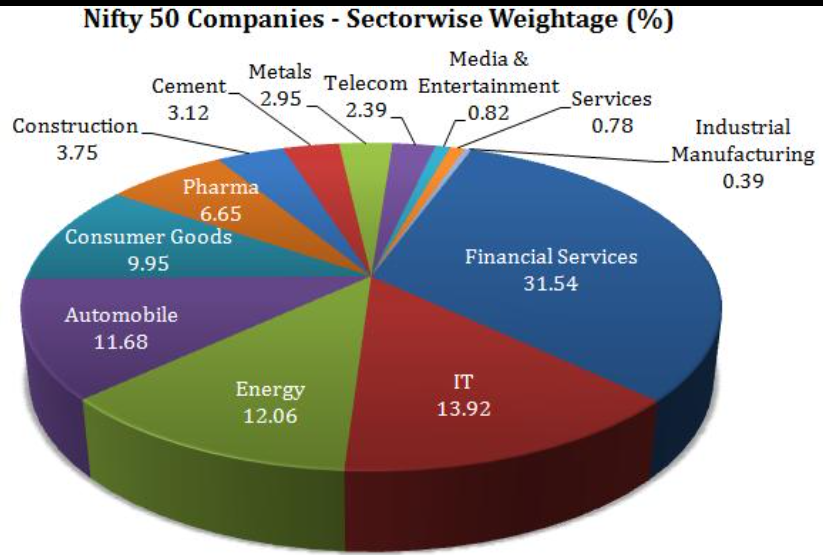
This is why sectors such as Banking, IT, and Energy frequently dominate market discussions and often play a major role in determining the direction of the broader market.
Note: Sector weightages are dynamic and change over time. The chart is provided for educational purposes to help understand the broad structure of the Indian market.
Lesson 1: Understanding Sectors & Industries
Before analyzing individual stocks, it is important to understand the larger groups to which companies belong. Businesses that operate in similar areas are grouped into sectors and industries, making it easier for investors to compare companies, identify trends, and understand market movements.
When investors say that “the banking sector is performing well” or “the IT sector is under pressure,” they are referring to a collection of companies that share similar business characteristics and are influenced by similar factors. Understanding these groupings helps investors see the bigger picture and avoid looking at stocks in isolation.
What Is a Sector?
A sector is a broad category of businesses that operate in a similar part of the economy.
For example, all banks provide financial services, so they are grouped under the Banking Sector. Similarly, software and technology companies are grouped under the Information Technology (IT) Sector.
Sectors help investors understand which parts of the economy are growing, struggling, or attracting investment.
Some of the major sectors in the Indian market include:
- Banking & Financial Services
- Information Technology (IT)
- Pharmaceuticals & Healthcare
- FMCG
- Automobile
- Realty
- Energy
- Metals & Mining
- Capital Goods
- Infrastructure
- Chemicals
- Telecom
What Is an Industry?
An industry is a more specific grouping within a sector.
Think of a sector as a large family and industries as smaller groups within that family.
For example:
Banking & Financial Services Sector
Industries within this sector may include:
- Private Banks
- Public Sector Banks
- NBFCs
- Insurance Companies
- Asset Management Companies
Automobile Sector
Industries within this sector may include:
- Passenger Vehicles
- Commercial Vehicles
- Two-Wheelers
- Auto Ancillaries
- Electric Vehicle Ecosystem
While companies within the same sector may face similar broad trends, industries often have their own unique opportunities and challenges.
Sector vs Industry
A simple way to understand the difference is:
- Sector = Broad Category
- Industry = Specific Business Group
Example:
Sector: Information Technology
Industries:
- IT Services
- Software Products
- Digital Consulting
- Cloud Services
- Cybersecurity
The industry provides a more detailed classification of a company’s business activities.
Why Investors Group Companies This Way
Grouping companies into sectors and industries helps investors:
- Compare similar businesses
- Identify market trends
- Understand common risks
- Track money flows
- Evaluate opportunities more effectively
Instead of comparing a bank with a pharmaceutical company, investors can compare banks with other banks and pharmaceutical companies with other pharmaceutical companies.
This creates a more meaningful analysis.
How Sectors Influence Stock Performance
One of the biggest mistakes beginners make is focusing only on individual stocks. In reality, a company’s performance is often influenced by what is happening in its sector.
For example:
- Rising interest rates can affect banking and real estate companies.
- Higher crude oil prices can impact aviation and paint companies.
- Increased government infrastructure spending can benefit capital goods and construction businesses.
- Strong global technology spending can support IT companies.
This is why understanding sectors is often just as important as understanding individual companies.Each sector has its own growth drivers, risks, economic sensitivities, and market cycles.
Key Takeaways
- A sector is a broad grouping of companies operating in a similar area of the economy.
- An industry is a more specific grouping within a sector.
- Companies within the same sector often respond to similar economic and market factors.
- Understanding sectors helps investors identify opportunities and risks more effectively.
- Sector analysis provides valuable context before analyzing individual stocks.
Lesson 2: Why Sector Analysis Matters
Many investors begin their investment journey by searching for individual stocks. They study company earnings, management quality, valuations, and business models in an effort to identify promising opportunities. While these factors are important, they represent only one part of the investment process.
Every company operates within a broader environment known as a sector. This environment influences demand, profitability, competition, growth prospects, and investor sentiment. As a result, the performance of a stock is often affected not only by company-specific factors but also by the sector in which it operates.
This is why professional investors rarely analyze stocks in isolation. Before evaluating individual companies, they first try to understand which sectors are strong, which sectors are weakening, and which areas of the market are creating opportunities.
Stocks Rarely Move in Isolation
One of the most important principles in investing is that stocks rarely move independently of their sector.
When favorable conditions emerge within a sector, multiple companies often benefit simultaneously. Likewise, when challenges affect a sector, even fundamentally strong businesses may experience pressure.
For example:
- Strong credit demand may benefit several banking companies.
- Rising technology spending may support multiple IT businesses.
- Higher metal prices may improve earnings across metal producers.
- Weak real estate demand may affect many housing-related companies.
This does not mean every stock will perform equally, but it does mean that sector conditions often influence a large group of companies at the same time.
The Market Is a Collection of Sectors
Many investors view the stock market as a collection of individual companies. In reality, the market is made up of sectors, industries, and businesses.
Major sectors such as:
- Banking & Financial Services
- Information Technology
- Energy
- FMCG
- Automobile
- Pharmaceuticals
- Metals
- Capital Goods
collectively drive the direction of the broader market.
Understanding sector behavior helps investors better understand what is happening beneath the surface of market movements.
Sector Analysis Provides Context
A company’s financial performance does not occur in a vacuum.
For example:
- A bank operates within the financial system.
- An automobile company depends on consumer demand and financing availability.
- An IT company depends on technology spending and global business conditions.
- A metal producer depends on commodity demand and pricing.
Without understanding the sector environment, it can be difficult to fully understand the opportunities and challenges facing a business.
Sector analysis provides the context in which company performance can be evaluated more effectively.
Sector Analysis Helps Narrow Opportunities
Thousands of companies are listed on Indian stock exchanges. Analyzing every stock individually is neither practical nor efficient.
Sector analysis helps investors narrow their focus.
Instead of asking:
Which stock should I buy?
Investors can first ask:
Which sectors appear attractive?
Once promising sectors are identified, investors can focus their research on companies operating within those areas.
This approach makes the investment process more structured and manageable.
Looking Beyond Individual Stocks
Investing success is not only about finding good companies. It is also about understanding the environment in which those companies operate.
A strong business operating within a favorable sector often has a greater probability of success than a similar business operating in a challenging environment.
For this reason, sector analysis serves as an important bridge between understanding the broader market and selecting individual stocks.
Key Takeaways
- Companies operate within sectors that influence their performance.
- Stocks rarely move completely independently of sector trends.
- The stock market is made up of sectors, industries, and companies.
- Sector analysis provides important context for evaluating businesses.
- Understanding sectors helps investors narrow their search and focus on areas of opportunity.
- Sector analysis should complement company analysis, not replace it.
Lesson 3: Cyclical vs Non-Cyclical Sectors
Not all sectors respond to economic conditions in the same way. Some sectors thrive when economic growth is strong, consumer spending is rising, and businesses are expanding. Others remain relatively stable regardless of whether the economy is booming or slowing down.
Understanding this difference is important because sector performance often changes throughout economic and market cycles. Investors who understand these patterns can better identify opportunities, manage risk, and build more balanced portfolios.
Broadly, sectors can be classified into two categories:
- Cyclical Sectors
- Non-Cyclical (Defensive) Sectors
What Are Cyclical Sectors?
Cyclical sectors are businesses whose performance is closely tied to economic growth.
When the economy is expanding, consumers spend more, businesses invest more, and demand increases. During these periods, cyclical sectors often experience strong revenue growth and improving profitability.
However, during economic slowdowns, demand weakens and these sectors may face pressure.
Common Characteristics
- Highly dependent on economic growth
- Benefit from rising consumer spending
- Sensitive to interest rates
- Often outperform during economic expansion
- Usually experience greater volatility
Examples of Cyclical Sectors
Banking & Financial Services
Higher economic activity generally leads to increased lending, borrowing, and financial transactions.
Automobile
Consumers are more likely to purchase vehicles when incomes and confidence are strong.
Realty
Real estate demand is heavily influenced by economic conditions and interest rates.
Capital Goods & Infrastructure
Business expansion and government spending often drive growth in these sectors.
Metals & Mining
Demand for metals is closely linked to manufacturing, construction, and industrial activity.
What Are Non-Cyclical (Defensive) Sectors?
Non-cyclical sectors provide products and services that people need regardless of economic conditions.
Even during recessions, consumers continue to buy food, medicines, electricity, and other essential products.
As a result, these sectors often experience more stable earnings and lower volatility.
Common Characteristics
- Demand remains relatively stable
- Less dependent on economic cycles
- Often provide consistent cash flows
- Usually perform better during uncertain periods
- Lower volatility compared to cyclical sectors
Examples of Defensive Sectors
FMCG
Consumers continue to purchase everyday products such as food, beverages, and household essentials.
Pharmaceuticals & Healthcare
Healthcare needs generally remain consistent regardless of economic conditions.
Utilities
Electricity, water, and other utility services are essential and often experience steady demand.
Consumer Staples
Products used in daily life tend to maintain demand even during economic slowdowns.
Wants vs Needs: A Simple Way to Understand the Difference
One of the easiest ways to understand cyclical and defensive sectors is to think about the difference between wants and needs.
During difficult economic periods, consumers may postpone:
- Buying a new car
- Purchasing luxury products
- Upgrading electronics
- Buying a new home
However, they still need:
- Food
- Medicines
- Electricity
- Basic household products
This is why sectors linked to discretionary spending are generally more cyclical, while sectors linked to essential spending are often considered defensive.
How Different Sectors Perform During Economic Cycles
During Economic Expansion
Investors often favor:
- Banking
- Automobile
- Realty
- Capital Goods
- Infrastructure
- Metals
These sectors typically benefit from stronger growth, rising demand, and increased spending.
During Economic Slowdowns
Investors often focus on:
- FMCG
- Pharmaceuticals
- Utilities
- Consumer Staples
These sectors are generally viewed as more resilient because demand remains relatively stable.
Cyclical Does Not Mean Better
One common misconception is that cyclical sectors are always superior investments.
In reality, performance depends on economic conditions and market expectations.
During periods of strong growth, cyclical sectors may outperform because demand and profitability improve rapidly.
During periods of uncertainty or slowing growth, defensive sectors may provide greater stability and sometimes outperform the broader market.
The objective is not to permanently favor one category over the other. The objective is to understand which sectors are likely to benefit from prevailing economic conditions.
Why This Matters to Investors
Understanding cyclical and defensive sectors helps investors:
- Interpret market behavior more effectively
- Understand why sectors perform differently
- Manage portfolio risk
- Prepare for changing economic conditions
- Identify opportunities across different market environments
Different sectors thrive under different conditions, and understanding these differences is an important step toward becoming a better investor.
Key Takeaways
- Cyclical sectors are closely tied to economic growth.
- Defensive sectors provide products and services that remain in demand regardless of economic conditions.
- Banking, Auto, Realty, Capital Goods, and Metals are common cyclical sectors.
- FMCG, Pharma, Utilities, and Consumer Staples are common defensive sectors.
- Different sectors perform differently across economic cycles.
- Cyclical sectors are not always better than defensive sectors.
- Understanding sector behavior helps investors make more informed decisions.
Lesson 4: Sector Rotation
One of the most important concepts in investing is understanding that money does not flow into all sectors equally or at the same time.
At any given point, some sectors attract investor attention while others are ignored. As economic conditions, market expectations, and investor sentiment change, capital gradually moves from one sector to another. This movement of capital is known as sector rotation.
Understanding sector rotation helps investors recognize changing market leadership, identify emerging opportunities, and better understand why some sectors outperform while others struggle.
What Is Sector Rotation?
Sector rotation refers to the movement of investment capital from one sector to another based on changing economic conditions and market expectations.
The stock market is forward-looking. Investors do not wait for economic data to fully confirm a trend. Instead, they try to anticipate future conditions and position themselves in sectors that are likely to benefit.
As a result, sector leadership often changes before economic conditions visibly change.
Why Does Sector Rotation Happen?
Different sectors benefit from different economic environments.
As conditions change, investors continuously reassess where future growth and profitability are likely to emerge.
Several factors can influence this process:
- Economic growth
- Interest rates
- Inflation
- Commodity prices
- Government policies
- Technological developments
- Global events
- Investor sentiment
As these factors evolve, some sectors become more attractive while others lose favor.
Understanding Sector Rotation Through an Example
Imagine the economy is recovering after a slowdown.
Investors begin to expect:
- Lower interest rates
- Higher lending activity
- Increased business investment
As a result, capital may start flowing into:
- Banking
- Capital Goods
- Infrastructure
As economic growth strengthens further, investors may become more optimistic about consumer spending and business expansion.
Capital may then move toward:
- Automobile
- Realty
- Consumer Discretionary
- Metals
Later, if inflation rises and growth begins to slow, investors may seek stability and gradually move toward:
- FMCG
- Pharmaceuticals
- Utilities
This ongoing shift of capital from one area of the market to another is sector rotation.
Typical Sector Behavior Across Economic Cycles
Early Recovery Phase
Sectors that often benefit:
- Banking
- Capital Goods
- Infrastructure
- Industrials
Why?
- Economic activity begins improving.
- Credit demand increases.
- Investment spending rises.
Growth Phase
Sectors that often benefit:
- Automobile
- Realty
- Consumer Discretionary
- Metals
Why?
- Consumer confidence improves.
- Spending increases.
- Business expansion accelerates.
Late Cycle Phase
Sectors that often benefit:
- Energy
- Commodities
- Select industrial sectors
Why?
- Commodity demand remains strong.
- Inflation pressures often increase.
Defensive Phase
Sectors that often attract investors:
- FMCG
- Pharmaceuticals
- Utilities
Why?
- Demand remains relatively stable.
- Earnings tend to be more predictable.
How Professional Investors Spot Sector Rotation
Sector rotation rarely begins with headlines.
By the time a sector becomes the most discussed theme in financial media, a significant portion of the move may already have occurred.
Professional investors therefore look for early signs that capital is moving into or out of a sector.
Relative Strength
One of the simplest methods is comparing sector performance with the broader market.
Example:
| Index | Return |
|---|---|
| Nifty 50 | +8% |
| Nifty Bank | +20% |
This suggests Banking is attracting more capital than the average market participant.
Consistent outperformance is often one of the earliest signs of sector leadership.
Broad Participation
A sector is usually stronger when multiple companies participate.
For example, if:
- HDFC Bank
- ICICI Bank
- SBI
- Axis Bank
are all performing well, the strength is likely sector-wide.
However, if only one stock is rising while most others remain weak, the move may be company-specific rather than sector-driven.
Institutional Activity
Large investors often rotate capital before retail investors recognize a trend.
Increasing participation from:
- FIIs
- DIIs
- Mutual Funds
may indicate growing confidence in a sector.
Earnings Momentum
Sector rotation is often supported by improving earnings across multiple companies.
When several businesses within the same sector begin reporting stronger growth, investors may start allocating more capital to that area.
Policy Support
Government initiatives can also trigger sector rotation.
Examples include:
- Infrastructure spending
- Defence modernization
- Manufacturing incentives
- Renewable energy programs
Markets often react to future expectations long before the benefits fully appear in company results.
Sector Rotation Is Not Always Obvious
Many investors expect sector rotation to occur suddenly.
In reality, it is often a gradual process.
A sector may begin outperforming months before it becomes a popular market theme. Similarly, a sector may continue rising even after positive news becomes widespread.
This is why successful investors focus on evidence rather than headlines.
The objective is not to predict every rotation perfectly. The objective is to recognize changing leadership early enough to understand where opportunities and risks may be emerging.
Common Mistakes Investors Make
Chasing Past Performance
Many investors enter a sector after it has already delivered strong returns.
Following Headlines Instead of Data
By the time a theme becomes widely discussed, a significant portion of the opportunity may already be reflected in prices.
Ignoring Broader Participation
A strong sector is usually supported by multiple companies, not just a single stock.
Assuming Leadership Never Changes
Market leadership evolves over time as economic and business conditions change.
Why Sector Rotation Matters
Understanding sector rotation helps investors:
- Identify emerging opportunities.
- Recognize changing market leadership.
- Understand where capital is flowing.
- Improve stock selection.
- Avoid chasing overcrowded themes.
Many successful investors focus on finding strong sectors first and strong companies second.
Key Takeaways
- Sector rotation refers to the movement of capital from one sector to another.
- Different sectors benefit from different economic and market conditions.
- Market leadership changes over time.
- Relative strength, broad participation, institutional activity, and earnings momentum can help identify sector rotation.
- Sector rotation often begins before headlines and becomes visible before economic trends are fully confirmed.
- Understanding sector rotation helps investors identify opportunities and risks more effectively.
Lesson 5: Factors Affecting Sector Performance
Why does one sector outperform while another struggles?
Why do banking stocks perform well during certain periods while pharmaceuticals lead during others? Why can the same sector become a market favorite one year and fall out of favor the next?
The answer lies in the various forces that influence sector performance.
Every sector responds differently to changes in economic growth, inflation, interest rates, commodity prices, government policies, global developments, and technological advancements. These factors can create opportunities for some sectors while creating challenges for others.
Understanding these relationships helps investors move beyond simply observing sector movements and begin understanding the reasons behind them.
The goal of sector analysis is not just to identify which sectors are moving, but to understand why they are moving.
Now for making Lesson 5 deeper, I think you’re missing one important concept:
Factors Do Not Affect All Sectors Equally
Add this after the introduction.
Same Event, Different Impact
A common mistake investors make is assuming that economic events affect all sectors in the same way.
In reality, the same event can create winners and losers simultaneously.
Example: Rising Crude Oil Prices
Beneficiaries:
- Oil Exploration Companies
- Energy Producers
Potentially Affected:
- Aviation
- Logistics
- Paint Manufacturers
The same event creates opportunities for some sectors and challenges for others.
Example: Falling Interest Rates
Beneficiaries:
- Banking
- Realty
- Automobile
- Infrastructure
Limited Impact:
- FMCG
- Utilities
Because different sectors have different business models and growth drivers.
This is why investors should focus not only on events but also on understanding which sectors are most sensitive to those events.
Then after all the factors, before Key Takeaways, add a powerful closing section:
Building a Sector Sensitivity Framework
One of the most useful habits investors can develop is connecting major market events with the sectors most likely to be affected.
For example:
| Event | Likely Beneficiaries | Potentially Affected |
|---|---|---|
| Lower Interest Rates | Banking, Realty, Auto | Savings-oriented businesses |
| Higher Crude Oil Prices | Energy Producers | Aviation, Logistics |
| Weak Rupee | IT, Pharma Exporters | Import-Dependent Industries |
| Infrastructure Spending | Capital Goods, Cement, Construction | Limited direct impact on Defensive Sectors |
| Rising Commodity Prices | Metals, Mining | Commodity Consumers |
| Strong Consumer Spending | Auto, Consumer Discretionary | Limited impact on Utilities |
Over time, investors begin to see markets as a network of interconnected relationships rather than a collection of isolated stocks.
This understanding often provides an advantage in identifying opportunities before they become obvious.
Lesson 6: Sector, Industry & Market Performance
Understanding sectors is important, but investors who stop at the sector level often miss where the real opportunities exist.
The stock market operates in layers. Every company belongs to an industry, every industry belongs to a sector, and every sector contributes to the broader market.
Market
↓
Sector
↓
Industry
↓
Company
Understanding how these layers interact helps investors identify where money is actually flowing and where the strongest opportunities may be emerging.
The Market Is Not Moving Equally
When investors say:
“The market is rising.”
It does not mean every sector or stock is rising equally.
For example:
- Nifty 50 gains 10%
- Banking gains 22%
- IT gains 6%
- Pharma gains 2%
Although the overall market is positive, Banking is clearly attracting more investor interest than other sectors.
This is why investors should look beyond headline index movements and understand which sectors are driving market performance.
Sector Performance vs Market Performance
Comparing sectors with the broader market helps investors identify areas of strength and weakness.
| Index | Return |
|---|---|
| Nifty 50 | +10% |
| Nifty Bank | +22% |
| Nifty IT | +6% |
| Nifty Pharma | +2% |
In this example:
- Banking is outperforming the market.
- IT is underperforming.
- Pharma is lagging significantly.
This suggests that investors are allocating more capital toward banking-related opportunities.
However, identifying a strong sector is only the first step.
Industry Performance Within a Sector
Even when a sector performs well, not every industry inside that sector performs equally.
This is where many investors stop too early.
Automobile Sector Example
The Automobile sector contains several industries:
- Passenger Vehicles
- Two Wheelers
- Commercial Vehicles
- Auto Ancillaries
- Tyres
- EV Ecosystem
Suppose performance looks like this:
| Industry | Return |
|---|---|
| Passenger Vehicles | +12% |
| Two Wheelers | +8% |
| Commercial Vehicles | +5% |
| Auto Ancillaries | +35% |
Most investors may conclude:
“The Auto sector is doing well.”
However, the real leadership is coming from Auto Ancillaries.
Investors who analyze industries rather than just sectors often identify opportunities much earlier.
A Strong Sector Does Not Guarantee a Strong Industry
Many investors correctly identify a strong sector but still fail to identify the strongest opportunity within it.
For example, an investor may correctly predict that the Automobile sector will perform well and invest in a commercial vehicle company.
However, the actual growth may be concentrated in:
- Auto Ancillaries
- EV Components
- Premium Passenger Vehicles
In this situation, the investor was correct about the sector but incorrect about the industry.
This demonstrates why industry-level analysis is often just as important as sector-level analysis.
The biggest winners are frequently found in the strongest industries within the strongest sectors.
Industry Rotation Within a Sector
Just as money rotates between sectors, it can also rotate between industries inside the same sector.
This is known as internal sector rotation.
Defence Sector Example
The Defence sector may contain:
- Defence Manufacturing
- Shipbuilding
- Aerospace
- Defence Electronics
- Drone Technology
- Surveillance Systems
Suppose the government increases spending on drone technology.
The strongest beneficiaries may be:
- Drone manufacturers
- Drone component suppliers
- Defence electronics companies
Meanwhile, other parts of the Defence sector may remain relatively unchanged.
An investor looking only at the overall Defence sector may miss where the real opportunity exists.
Why Industry Analysis Matters
Industry analysis helps investors:
- Identify niche opportunities.
- Understand emerging themes.
- Detect changing market trends.
- Find areas attracting capital.
- Improve stock selection.
Many of the biggest market winners emerge from industries that initially represent only a small part of a larger sector.
Finding the Strongest Companies
After identifying a strong industry, investors can narrow their focus to individual businesses.
Suppose Auto Ancillaries are outperforming other parts of the Automobile sector.
The next questions become:
- Which companies have the strongest growth?
- Which companies have the highest market share?
- Which companies are benefiting most from the trend?
- Which companies are attracting institutional interest?
- Which companies have the strongest competitive advantages?
This process helps investors move from a broad theme to a specific investment opportunity.
A Practical Framework
When evaluating opportunities, investors can follow a simple process:
Step 1: Market
Which sectors are outperforming the broader market?
Step 2: Sector
Which sectors are attracting the most investor interest?
Step 3: Industry
Which industries are driving growth within those sectors?
Step 4: Company
Which businesses are best positioned to benefit?
Following this approach helps investors focus on opportunities where multiple factors are working in their favor.
Key Takeaways
Strong opportunities are often found in the strongest industries within the strongest sectors.
The stock market operates through a hierarchy of Market → Sector → Industry → Company.
Strong sectors often outperform the broader market.
Not all industries within a sector perform equally.
A strong sector does not automatically mean every industry within that sector is attractive.
Internal sector rotation can create opportunities that may not be visible at the sector level.
Industry analysis helps investors identify where growth is actually occurring.
Lesson 7: Finding the Winner – Why Business Quality Matters
By now, we have learned how to identify strong sectors, understand sector rotation, analyze industry performance, and recognize where opportunities may be emerging.
However, there is one final piece of the puzzle.
Identifying a strong sector does not automatically lead to a successful investment.
The biggest mistake investors make is assuming that every company operating in a promising sector will perform well.
In reality, sectors create opportunities, but businesses determine outcomes.
A Good Sector Cannot Fix a Weak Business
Imagine two companies operating in the same industry.
Both benefit from:
- The same economic conditions
- The same industry growth
- The same customer demand
Yet over time, one company becomes a market leader while the other struggles.
Why?
Because business performance depends on factors that sector analysis cannot fully explain.
These include:
- Management quality
- Capital allocation
- Competitive advantages
- Financial strength
- Execution capability
- Corporate governance
A favorable sector may provide a tailwind, but it cannot permanently compensate for weak business fundamentals.
Why Companies in the Same Industry Perform Differently
Even within the same industry, businesses often achieve very different results.
Consider two automobile manufacturers.
Both operate in the same sector.
Both face the same economic conditions.
Both sell to similar customers.
Yet one company may:
- Gain market share
- Improve margins
- Launch successful products
- Generate superior returns
While another may struggle due to:
- Poor execution
- Weak product positioning
- Rising debt
- Inefficient operations
This is why investors should not stop their analysis at the sector or industry level.
Understanding Risk and Reward
As investors move down the investment hierarchy, both potential reward and risk increase.
Market
↓
Sector
↓
Industry
↓
Company
Market Level
Provides the broadest view with the lowest company-specific risk.
Sector Level
Helps identify areas benefiting from favorable conditions.
Industry Level
Narrows the focus to where growth is actually occurring.
Company Level
Offers the greatest opportunity for outperformance, but also carries the highest business-specific risk.
This is where investment success is ultimately determined.
What Makes a High-Quality Business?
While every industry is different, strong businesses often share common characteristics.
Strong Competitive Advantage
The company possesses strengths that competitors struggle to replicate.
Healthy Financial Position
The business maintains manageable debt and generates sustainable cash flows.
Consistent Profitability
The company demonstrates an ability to earn profits across different market conditions.
Capable Management
Management allocates capital wisely and executes long-term strategies effectively.
Market Leadership
Leading companies often benefit from stronger brands, customer trust, and economies of scale.
Sector Analysis vs Business Analysis
Sector analysis helps investors answer:
- Where is growth occurring?
- Which sectors are attracting capital?
- Which industries are benefiting from current conditions?
Business analysis helps answer:
- Which company is best positioned?
- Which company has the strongest fundamentals?
- Which company can sustain growth over the long term?
Both forms of analysis are important.
Neither should replace the other.
The Best Investment Combination
Many successful investments share a common characteristic:
A strong business operating within a strong industry and a strong sector.
When all three align, investors benefit from:
- Favorable sector conditions
- Industry growth
- Company-specific execution
This combination often creates the most attractive long-term opportunities.
Key Takeaways
- Sector analysis helps identify opportunities, but business analysis identifies potential winners.
- A strong sector cannot permanently compensate for a weak business.
- Companies within the same industry can produce very different outcomes.
- Management quality, financial strength, competitive advantages, and execution remain critical.
- Risk and reward increase as investors move from market-level analysis to company-level analysis.
- The strongest opportunities often emerge when a high-quality business operates within a strong industry and a strong sector.