

A Retail Investor’s Confession: The Pain Behind the Market
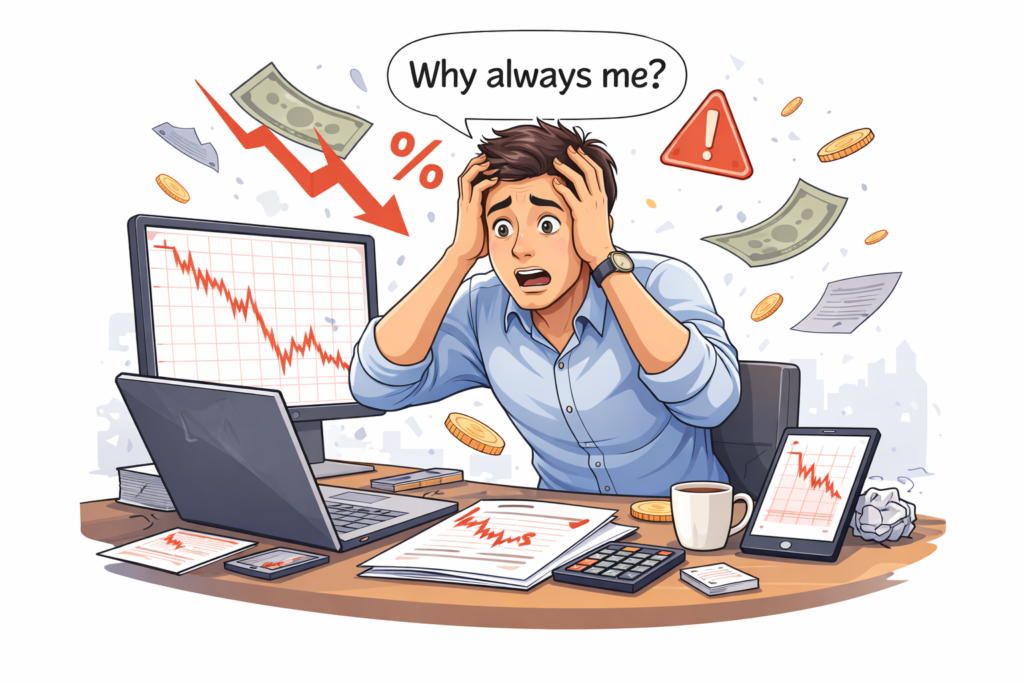
Firstly, let me clarify. I am not a fund manager, not one who managing billions of dollars nor a hedge fund trader. I am the person everyone in the market talks about- The retailer (I am a retail investor).
Moving forward with most obvious statement – “Retail investors are not market movers. We do not have billions to push prices—we only react to what the market shows us.”
Today, after watching the market fall and my portfolio bleeding and panic all-around, I am drafting this article- not as an expert. I am writing this as someone trying to understand the mistakes I made in the past.
In the market, there is one sentence that keeps echoing again and again:
- Retail investors are too many in this stock — don’t buy it.
- In F&O, if retailers dominate the trade, it will likely fail.
- Retail investors always chase price and rarely study the market properly.
Every time I hear it, it sounds like a warning — almost like a red flag.
Sometimes I wonder: When did the word “retail” itself become a warning sign?
Hearing these statements repeatedly can feel frustrating. Because most retail investors are not careless gamblers. Many of us spend hours studying charts, reading news, and trying to understand companies. We try to learn from books, videos, and market discussions. Yet somehow, the label remains the same. “Retail always arrives late.”
“This is not meant as a personal comment, but a commonly used phrase referring to retail investors as a group.” Lets understand why this is said.
Looking Back at My Own Decisions
When I look back honestly at some of my past decisions, I notice a pattern. Many times I bought stocks after they had already moved significantly. A stock that rose 30% suddenly looked strong. A stock that doubled seemed like a proven winner.
At that moment the logic felt simple:
If the stock has already moved so much, there must be something good about it.
But what I didn’t realize then was something important. I was looking at the past, while the market was already pricing the future. By the time I noticed the opportunity, someone else had already discovered it much earlier.
Many retail decisions are influenced by recent price movement.
- If a stock rallied yesterday, we expect it to rally tomorrow.
- If a stock crashed today, we panic and sell.
- If everyone around us is buying, we feel safer buying too.
My Panic Selling
When markets fall sharply, many retail investors react with fear. Seeing continuous losses on the screen creates pressure and uncertainty. Instead of analysing the situation calmly, panic takes over. In that moment, many retail investors sell quickly or exiting all their positions just to stop the pain.
Sometime, this panic selling often happens near market bottoms, turning temporary declines into permanent losses.
This behaviour is not stupidity. It is human psychology.
No one wants to feel left behind when others are making. The fear of missing out is powerful. Also, sometimes the fear of losing money becomes stronger than the patience required to stay invested. In both condition the market often takes advantage of that emotion.
Where Retail Investors Usually Get Trapped
Retail traps rarely happen at the beginning of a trend. They usually appear after the move becomes visible and exciting. Some common situations where retail investors get trapped are:
1. After a Big Price Rally
When a stock has already moved 50–100%, it starts appearing in screeners, media discussions, and social media posts. Retail investors enter believing the momentum will continue, but often this is where early investors begin booking profits.
2. Breakout After Long Rally
Many retail traders buy breakouts without asking an important question: Is this the first breakout or the fourth? Late-stage breakouts often fail because the trend is already mature.
3. “Buy the Dip” in Weak Stocks
Retail investors often assume that if a stock was once at ₹500 and now trades at ₹300, it must be cheap. But price memory does not guarantee value. Sometimes the business itself has deteriorated.
4. Crowded F&O Trades
When too many traders buy the same call or put options, the trade becomes crowded. Option premiums decay with time, and many retail traders lose money even if the price does not move much.
5. News-Based Buying
Retail investors frequently buy stocks after positive news becomes public. But markets often price in good news much earlier, which means the opportunity may already be largely captured.
Most retail traps appear not when the opportunity begins, but when the opportunity becomes obvious.
The Desire to Earn Money Quickly
Another trap many retail investors fall into is the desire to earn money in a very short time.
Markets move slowly most of the time, but retail investors often expect fast results. When we see others making quick profits, the temptation becomes stronger. We start believing that the market is a place where money can be multiplied quickly.
This mindset pushes many retail investors toward high-risk trades, especially in F&O or momentum chasing.
Instead of asking “Is this a good opportunity?” the mind begins asking “How quickly can I make money from this?”
And that small shift in thinking changes everything.
Because when the focus becomes speed rather than quality of opportunity, decisions become emotional. Positions become larger than they should be. Risk management disappears.
The market does not punish impatience immediately. Sometimes quick profits happen in the beginning, which strengthens the belief that fast money is possible.
But over time, the market quietly teaches a harsh lesson: The faster we try to make money, the faster we often lose it.
What I Learned: Possible Solutions from this-
After reflecting on my mistakes, I realized that surviving in the market requires a different way of thinking. Some lessons have become very clear to me. The Timing Difference
The real difference between large investors and retail investors may not be intelligence.
It may simply be timing.
Large investors often look for opportunities before they become obvious.
Retail investors often notice opportunities after they become visible.
That small difference in timing changes everything.
1.Understanding the Market Cycle
In many cases, the market follows a quiet cycle:
- Early Stage: Nobody is interested. The stock moves slowly and quietly.
- Middle Stage: The trend becomes visible. Early investors are already in profit.
- Late Stage: The story spreads widely. Retail participation increases.
By the time the opportunity becomes obvious, a large part of the move may already be over.
2. Never Ignore Macroeconomic Factors
Markets do not move in isolation. Interest rates, liquidity, inflation, government policies, and global economic conditions influence capital flows. Ignoring the macro environment is like trading without understanding the weather.
3.Understand the Direction of the Country
A country’s economic direction often shapes the next big investment opportunities. Government policies, infrastructure spending, manufacturing growth, energy transition, and technological development create long-term demand. Smart investing often aligns with where the country is heading.
4. Always Ask: Where Is the Wind Blowing
Every market cycle has sector tailwinds. Sometimes the money flows into defence, sometimes energy, sometimes infrastructure or digital technology. Instead of chasing random stocks, it is important to identify which sector the capital is moving into.
5. Study Demand and Supply
At its core, the market is driven by demand and supply. When demand is stronger than supply, prices rise. When supply overwhelms demand, prices fall. Understanding this simple principle can reveal far more than complicated indicators.
6. Volume Rarely Lies
Price can sometimes mislead, but volume often tells the truth. Unusual volume spikes may signal accumulation, distribution, liquidity sweeps, or stop-loss hunting. Understanding volume behavior can help distinguish between real moves and market traps.
6. Quick Money Is a Dangerous Illusion
One of the biggest traps for retail investors is the desire to make money quickly. Markets reward patience, not impatience. The more we chase fast profits, the more mistakes we tend to make.
These are not perfect solutions. But they are reminders that surviving in the market requires discipline, patience, and a willingness to learn from painful experiences.
A Personal Realization
This realization is uncomfortable; because it forces me to ask an honest question:
Maybe the problem was never that retail investors lack intelligence. Maybe the real issue is that we are trained to look at the market only after it becomes exciting.
And the market rarely rewards excitement. It rewards patience, quiet observation, and the ability to notice what others have not yet seen. A reminder that the market often becomes most dangerous exactly when it feels the most obvious.
This is place where I am failing.
Disclaimer
I am not a SEBI-registered investment advisor. This article is written purely to share personal thoughts, experiences, and reflections as a retail investor. I may be unintentionally mixing different thoughts and emotions while expressing my experience.
The purpose of this article is not to influence anyone’s investment decisions. It should not be considered financial or investment advice.
I also have no intention of hurting the sentiments of any individual, community, or professional opinion in the market. The views expressed here are personal observations based on my own learning and experiences.
Readers are advised to do their own research and consult a qualified financial advisor before making any investment decisions”.