

From Missiles to Markets: How Wars Move the Stock Market
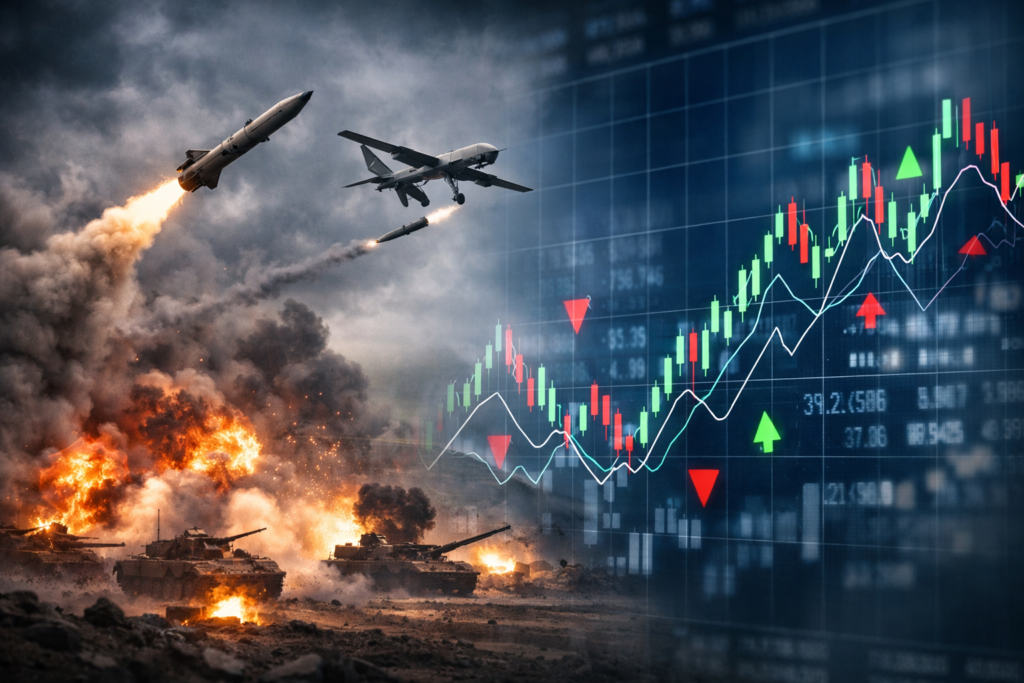
When war begins, financial markets face uncertainty, and traders experience a strong psychological conflict. Fear of economic disruption and market crashes pushes many investors toward panic selling and risk aversion. At the same time, experienced traders recognize that wars often trigger major sector shifts in areas such as energy, commodities, and defence.
This creates an internal battle: one side urges protection of capital, while the other sees potential opportunity in market dislocation. Continuous news flow and geopolitical developments further intensify emotions, causing markets to swing between panic and optimism.
In such periods, the biggest challenge for traders is not just analyzing the market but controlling their own psychology.
I know it is very easy to say, but much more difficult to follow in practice.
Those who remain disciplined and focus on long-term structural trends often find opportunities hidden within the chaos.
Key Economic Factors That Can Lead to War-
Wars are often influenced by underlying economic pressures. The most common economic factors include:
1. Competition for Natural Resources
Countries may fight to control valuable resources such as oil, gas, minerals, water, or fertile land.
2. Energy Security
Nation’s dependent on external energy supplies may enter conflicts to secure stable access to oil or gas.
3. Trade and Economic Rivalry
Intense competition between major economies for global market dominance can escalate tensions.
4. Control of Strategic Trade Routes
Important shipping routes, canals, and chokepoints are vital for global commerce. Control over them provides economic and strategic advantage.
5. Economic Crisis or Inequality
Severe economic stress or large wealth gaps between nations can increase geopolitical instability.
6. Military Spending and Strategic Power
Defence industries and national security priorities often drive higher military investment during geopolitical tensions.
In most cases, wars result from a combination of these economic pressures rather than a single cause.
How Wars Reshape Stock Market Trends: Historical Evidence and Sector Shifts
Wars and geopolitical conflicts have repeatedly reshaped sector leadership in global stock markets. While conflicts initially trigger fear and volatility, historical data shows a surprisingly consistent pattern in how markets react and which sectors eventually benefit.
Across multiple conflicts, markets tend to follow a predictable sequence:
- Initial shock → market decline
- Commodity spike → sector rotation
- Defence and energy rally
- Post-war restructuring → emergence of new long-term winners
Below are key historical examples that demonstrate this pattern.
1. Gulf War (1990–1991)
The Gulf War began in 1990, when Iraq invaded Kuwait, triggering a U.S.-led coalition military response in 1991.
Immediate Market Reaction
The invasion created immediate uncertainty in global markets.
Major developments included:
- Oil prices surged sharply due to fears of supply disruption.
- Global equity markets initially declined because of geopolitical risk.
- Investors moved capital toward energy and defence sectors.
The primary economic driver during this period was energy supply risk.
Sector Shifts
Winners
- Oil and energy companies
- Defence contractors
Losers
- Airlines
- Tourism companies
- Transportation companies
Higher fuel costs and travel uncertainty negatively affected transport-related industries.
Structural Outcome
The Gulf War accelerated long-term investment in:
- Energy infrastructure
- Military and defence technology
Defence companies experienced sustained demand growth following the conflict as governments increased military spending.
2. Iraq War (2003)
The Iraq War began in 2003, following months of geopolitical tension and military preparation.
Market Behaviour
Before the invasion began, global stock markets declined due to uncertainty.
However, once military operations started, markets rallied strongly.
This pattern is commonly described as:
“Sell the fear, buy the clarity.”
Investors had already priced in the worst-case scenario. Once uncertainty was removed, capital returned to equities.
Sector Trends
Major Beneficiaries
- Oil exploration companies
- Oil services and drilling companies
- Defence contractors
- Infrastructure companies
Large amounts of global capital flowed into:
- Energy exploration
- Military supply chains
- Reconstruction projects in conflict zones
3. Russia–Ukraine War (2022)
The Russia–Ukraine War, which began in 2022, triggered one of the largest commodity shocks in recent decades.
Major Commodity Impact
Russia and Ukraine are major global suppliers of critical commodities. The war disrupted supply chains and caused sharp price increases in:
Energy
- Oil
- Natural gas
- Coal
Agricultural Commodities
- Wheat
- Fertilizers
These disruptions contributed significantly to global inflation during 2022–2023.
Global Stock Market Winners
Energy companies benefited from rising oil and gas prices.
Major global winners included:
- ExxonMobil
- Chevron
Defence companies also surged as NATO countries increased military spending in response to geopolitical tensions.
Impact on the Indian Stock Market
The conflict indirectly boosted several sectors in India.
Defence Sector
- Hindustan Aeronautics Limited
- Bharat Electronics Limited
Energy and Coal
- Coal India
These companies benefited from increased focus on energy security and defense capability expansion.
4. Cold War Technology Race (1947–1991)
The Cold War between the United States and the Soviet Union lasted from 1947 to 1991.
Although it was not a direct battlefield war between the two superpowers, the geopolitical rivalry triggered massive technological innovation.
Government Investment in Technology
Military competition drove heavy investment in:
- Aerospace technology
- Satellite communication
- Early computing systems
- Semiconductor development
Long-Term Economic Impact
Many technologies developed during the Cold War later became foundations of the modern digital economy.
Major technology companies that benefited from these developments include:
- Intel
- IBM
This period demonstrates how geopolitical competition can create entirely new industries.
5. US–China Strategic Competition (2018–Present)
The economic rivalry between the United States and China intensified in 2018, when tariffs were imposed on large volumes of Chinese exports.
Structural Global Shift
The conflict triggered a major transformation in global supply chains.
Companies began relocating manufacturing away from China to other countries such as:
- India
- Vietnam
- Mexico
This shift is often described as “China +1 manufacturing strategy.”
Beneficiary Sectors in Emerging Markets
Countries receiving new manufacturing investment saw growth in sectors such as:
- Electronics manufacturing
- Specialty chemicals
- Renewable energy supply chains
An example in India is solar manufacturing, where companies such as Borosil Renewables benefited from the global shift toward non-Chinese supply chains.
Historical Pattern Observed
Across multiple conflicts and geopolitical tensions, a clear pattern emerges.
| Phase | Market Behaviour |
| Conflict begins | Market volatility and uncertainty |
| Commodity shock | Energy and metals prices rise |
| Military spending increases | Defence sector rallies |
| Supply chains adjust | New industries and sectors emerge |
Key Investment Insight
Wars rarely cause permanent damage to financial markets.
Instead, they often accelerate structural economic changes.
The biggest investment opportunities tend to appear in sectors connected to:
- Energy transition
- Defence technology
- Supply chain relocation
- Commodity cycles
Investors who understand these patterns can often identify emerging sector trends before they become widely recognized by the market.
Conclusion
Geopolitical conflicts may create short-term volatility, but they also reshape the global economic landscape. From energy shocks to technological innovation and supply chain transformation, wars have historically been catalysts for major market shifts.
Studying past conflicts provides valuable insight into how global capital flows evolve during periods of geopolitical tension—and where the next major investment opportunities may emerge.
Disclaimer
I am not a SEBI-registered or authorized stock market advisor. The stocks, sectors, or market examples mentioned in this article are not recommendations to buy or sell any security. They are used only for educational and informational purposes.
The author has no intention to influence investment decisions or cause financial or psychological harm to any individual or group. Readers should conduct their own research and consult a qualified financial professional before making any investment decisions.
The information, ideas, and perspectives presented here are compiled from various publicly available sources, including books, articles, research papers, and web content. This article represents a compilation and interpretation of those ideas.
The content is intended purely for learning, discussion, and understanding market behaviour and psychology. It should not be considered financial, investment, or trading advice.
While efforts have been made to keep the information accurate, there may be unintentional errors due to human interpretation, data limitations, or source inaccuracies. Therefore, readers should not rely solely on this material for financial decisions and should conduct their own independent research.